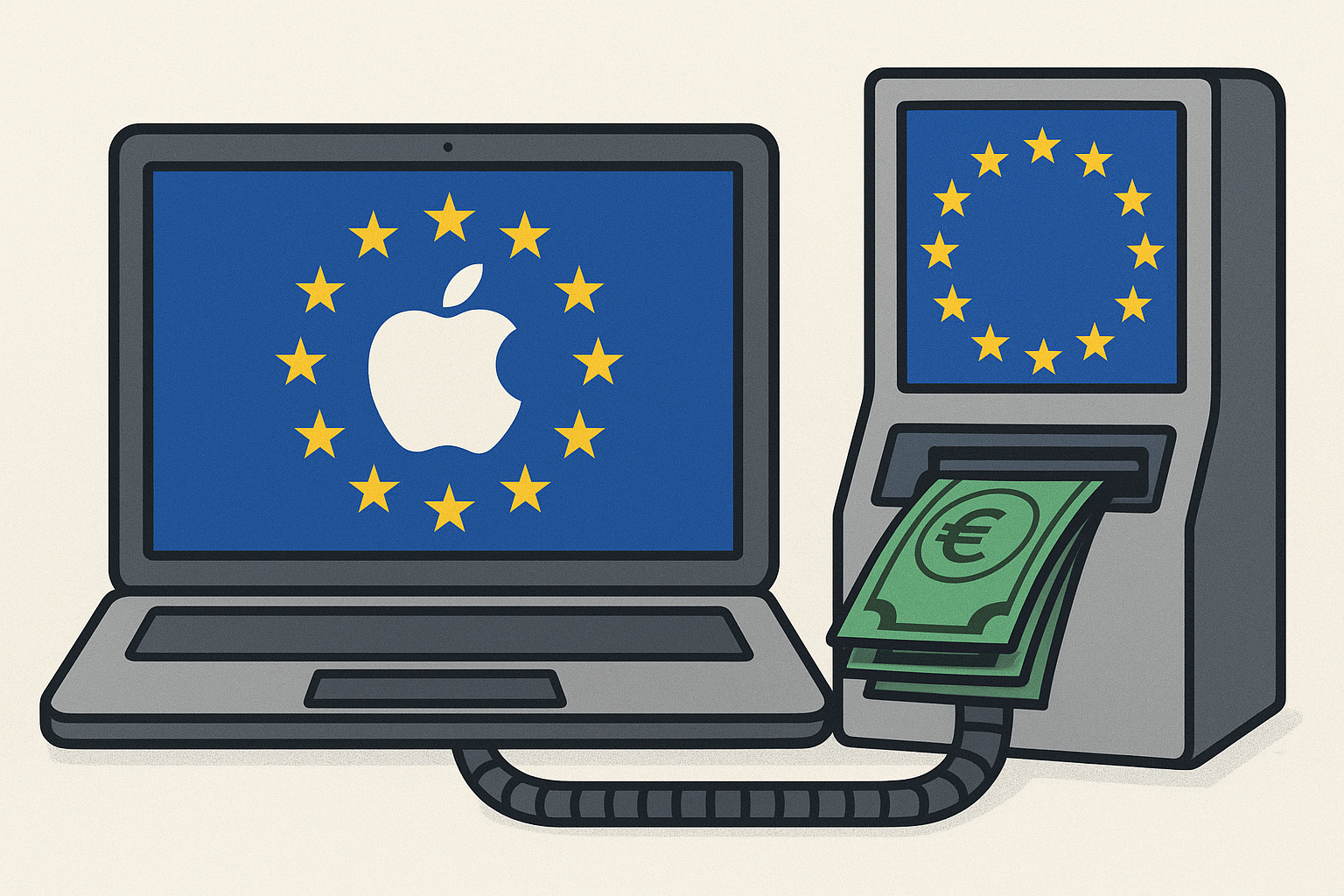
The pattern has become unmistakable: a successful American technology company expands into Europe, builds a loyal user base, and then finds itself in the crosshairs of European Union regulators wielding billion-euro fines and existential threats to their business models. What European officials frame as consumer protection and competition enforcement increasingly looks like a sophisticated shakedown operation—a way for a technologically stagnant continent to extract wealth from innovators it cannot match.
The Staggering Financial Toll
The numbers reveal a systematic targeting of American innovation. Google has been hit with over €8.2 billion in antitrust fines across three separate cases. The largest, a €4.34 billion penalty in 2018, centered on Android’s bundling practices—the very model that made smartphones affordable and accessible to billions globally. Another €2.42 billion came from allegedly favoring its own shopping service in search results. A third penalty of €1.49 billion targeted advertising contracts.
Apple faced a €13 billion tax bill from the EU Commission, which unilaterally decided that Ireland’s tax arrangement with the company constituted illegal state aid. Never mind that Ireland itself—the supposed victim—vehemently opposed the ruling and fought alongside Apple to overturn it. Brussels knew better than the Irish government what was good for Ireland.
Meta has endured a steady drumbeat of GDPR fines: €1.2 billion for data transfers, €390 million for advertising practices, €265 million for a data breach. Amazon received a €746 million fine for advertising targeting practices. Intel faced a €1.06 billion antitrust fine. Microsoft has paid hundreds of millions over various compliance issues spanning decades.
Tally the figures and American tech companies have transferred well over €15 billion to European coffers in just the past decade. For context, that exceeds the entire annual budget of many EU member states. These aren’t traffic tickets—they’re wealth transfers of historic proportions.
Other Top Florida News:
• Boca Raton Fl Social Security Disability Law Firm
• South Florida Public Relations Firm BoardroomPR
• Central Florida Health Scare: 4 Restaurants Shut Down Last Week
• Hurricane Ian Home Insurance Law Firm ILG Group
• South Fl SEC RIA Legal Defense Law Firm Nason Yeager
European Tech: A Graveyard of Ambition
What makes this financial extraction particularly galling is Europe’s abject failure to build competitive alternatives. The continent that produced Newton, Curie, and Einstein somehow cannot manage to create a single technology company of global significance.
Where is Europe’s search engine? Its social network? Its smartphone operating system? Its cloud computing platform? Its artificial intelligence leader? These aren’t rhetorical questions with obscure answers—there simply are no answers. Nokia once dominated mobile phones but fumbled the smartphone transition. SAP remains relevant in enterprise software but hasn’t innovated significantly in decades. Spotify exists primarily to complain about Apple while building its business on the backs of Apple’s platform.
The contrasts are stark. America has Apple, Microsoft, Google, Amazon, Meta, and NVIDIA among its top companies. China has Tencent, Alibaba, and ByteDance. Europe’s most valuable companies? Luxury goods makers, pharmaceutical firms, and oil companies. The digital revolution might as well have bypassed Brussels entirely.
This failure isn’t due to lack of talent—Europe has world-class engineers and researchers. It’s not lack of education—European universities produce excellent graduates. The problem is structural: risk-averse venture capital, fragmented markets across language barriers, labor regulations that make hiring and firing nearly impossible, and a cultural suspicion of entrepreneurial success.
Rather than confront these uncomfortable truths, European regulators have chosen a different path: handicap the competition through regulatory warfare.
The Gatekeeper Gambit: Rules Written for American Companies
The Digital Markets Act represents the most brazen example of regulation designed to target American success specifically. The law designates certain platforms as “gatekeepers” subject to extensive obligations and restrictions. The criteria—40 million monthly EU users, €7.5 billion in annual EU revenue, market capitalization of €75 billion—were calibrated with laser precision to capture American platforms while exempting European companies.
Look at who made the list: Google, Apple, Meta, Amazon, Microsoft, and ByteDance. Notice who didn’t: any significant European company. Spotify lobbied intensely for the law but conveniently falls below the thresholds. The same goes for Booking.com and other European platforms that exercise substantial market power in their niches.
The obligations imposed on gatekeepers read like a wishlist designed to kneecap successful business models. Apple must allow alternative app stores, undermining the security model that made iOS trustworthy and opening the door to malware and fraud. Google must present choice screens for search and browsers, degrading user experience to benefit competitors who couldn’t build superior products. Meta must make its messaging platforms interoperable with rivals, forcing it to share the network effects it spent billions building.
Consider the absurdity: Apple created the App Store ecosystem, invested billions in development tools, security infrastructure, and payment processing. Developers voluntarily choose to build on iOS because of its affluent user base and superior development environment. Now Brussels demands Apple give competitors free access to that ecosystem without bearing any of the costs or risks Apple shouldered for over a decade.
These aren’t neutral competition rules—they’re targeted strikes against specific American business models. European companies that bundle products or leverage platform effects face no equivalent restrictions. Where are the gatekeeper obligations on European automakers that lock customers into proprietary service networks? Where are the restrictions on European telecoms that bundle services and lock customers into contracts? The selectivity is damning.
The GDPR: Protectionism in Privacy Clothing
The General Data Protection Regulation arrived in 2018 draped in the noble language of privacy protection. In practice, it functions as a nearly perfect non-tariff barrier against American tech expansion.
The compliance burden is enormous: data protection officers, consent management systems, data mapping exercises, privacy impact assessments, breach notification procedures, and endless documentation. Large American companies spent hundreds of millions achieving compliance. Google reportedly spent over $200 million on GDPR compliance. Facebook employed thousands of staff for privacy compliance. Smaller firms simply gave up on European expansion entirely—too expensive, too risky, too complicated.
Meanwhile, European companies already navigating the continent’s regulatory maze faced lower relative costs. They understood the bureaucratic culture, spoke the languages of regulators, and could leverage existing compliance infrastructures from other EU regulations. A German Mittelstand company dealing with EU regulations for decades can add GDPR compliance incrementally. An American startup trying to expand internationally faces a regulatory wall.
The enforcement reveals the double standard. American companies face the maximum fines—calculated as percentages of global revenue, not just European operations—for technical violations. When Amazon used customer data to inform its private label decisions, that warranted €746 million. When European companies engage in similar practices, investigations move slowly if they materialize at all.
The data transfer restrictions deserve special mention. The EU invalidated Privacy Shield, the framework allowing transatlantic data flows, then fined Meta €1.2 billion for continuing transfers that were essential to operating a global platform. The theory? American surveillance laws make US data storage inherently unsafe for Europeans. Never mind that European intelligence agencies conduct surveillance too, or that the practical effect is forcing American companies to build expensive duplicate infrastructure in Europe.
Essentially, Europe demanded Meta either operate an entirely separate European infrastructure—impossibly expensive—or stop serving European users. It’s regulatory hostage-taking dressed up as privacy protection. The same data flowing to servers in Frankfurt is safe; flowing to servers in Virginia is an existential threat requiring billion-euro fines.
Selective Enforcement and Moving Goalposts
Google’s shopping case illustrates how EU enforcement operates with predetermined outcomes. After a seven-year investigation, the Commission determined that showing Google Shopping results prominently in search results constituted abuse of dominance. The implicit theory: Google must disadvantage its own superior product to give traffic to inferior competing services.
Think about this logic. Google invested billions building the world’s best search engine. It then invested more billions building a shopping comparison service. When it displays its own service prominently in its own search results—something every business does—Brussels calls it anticompetitive. Imagine forcing Walmart to give equal shelf space to Target products, or demanding McDonald’s promote Burger King in its restaurants. The theory makes no sense outside the context of extracting fines from a successful American company.
Google complied by creating choice boxes and auction systems for shopping ads. It submitted multiple proposals trying to satisfy Brussels’ demands. The Commission still wasn’t satisfied. Competitors who’d built business models around free Google traffic felt entitled to that traffic in perpetuity. When is compliance enough? When European competitors are satisfied—a standard impossible to meet.
The Android case proved even more absurd. Google offers Android free to device makers, spurring an explosion of affordable smartphones globally. Android powers over 70% of smartphones worldwide, creating opportunities for manufacturers from Samsung to countless Chinese brands. But because Google requires manufacturers to pre-install Chrome and Search to recoup its investment in developing Android, the EU deemed this anticompetitive.
The alternative Google proposed—charging licensing fees like Microsoft does for Windows—would have made smartphones significantly more expensive for consumers. That apparently was preferable to European regulators than allowing Google’s free model. The real objective wasn’t consumer welfare; it was punishing Google’s success and extracting a massive fine.
Apple’s tax case revealed the EU’s willingness to invent retroactive legal theories. Ireland offered Apple favorable tax treatment to attract investment and jobs. This wasn’t a secret backroom deal—it was official Irish tax policy, approved by Irish authorities, consistent with Irish law. Apple employed thousands in Ireland, invested billions in facilities, and followed every rule.
For years, no one objected. Then, suddenly, in 2016 the Commission decided this constituted illegal state aid—going back a decade. Commissioner Margrethe Vestager held press conferences declaring Apple had received illegal benefits. The demand: €13 billion in back taxes plus interest.
Ireland itself opposed the ruling. Irish officials testified that no special deal existed, that Apple paid what Irish law required. But Brussels knew better. The Commission would decide Irish tax policy, overruling Ireland’s elected government. Even the European Court of Justice eventually recognized this overreach and overturned the decision in 2020, but only after years of legal limbo, reputational damage, and uncertainty that discouraged other American companies from European investment.
Qualcomm and Intel: Punishing Innovation in Chips
The semiconductor cases reveal how far EU overreach extends. Intel faced a €1.06 billion fine in 2009 for offering rebates to computer manufacturers who used Intel chips exclusively. The practice, common across industries, was deemed anticompetitive because Intel held significant market share.
Intel spent over a decade fighting the fine through appeals. In 2022, the European Court of Justice finally overturned the decision, finding the Commission had failed to prove consumer harm. But the damage was done—Intel had paid the fine, spent hundreds of millions on legal fees, and endured years of reputational attack. The Commission’s response to losing? Announcing it would pursue the case again with better evidence.
Qualcomm faced similar treatment, hit with fines totaling €997 million for agreements with Apple and alleged predatory pricing. The specifics involved complex licensing arrangements for cellular technology patents. Qualcomm argued its agreements reflected fair value for groundbreaking technology enabling the smartphone revolution. Brussels saw anticompetitive behavior requiring massive penalties.
These cases share a pattern: American companies that invested billions in research and development, created transformative technologies, and enabled entire industries face punishment for successful commercialization. European semiconductor companies that failed to innovate face no penalties—you can’t abuse dominance you never achieved.
The Innovation Penalty
Perhaps most damaging is how EU regulation punishes innovation itself. The AI Act, finalized in 2024, imposes extensive requirements on artificial intelligence systems, requiring conformity assessments, risk classifications, transparency obligations, and human oversight for “high-risk” systems.
American companies leading in AI—OpenAI, Google, Microsoft, Anthropic, Meta—face compliance costs running into hundreds of millions and deployment restrictions that could prevent offering cutting-edge capabilities in Europe. Meanwhile, European AI companies, which barely exist at frontier levels, face… well, they don’t face anything because they’re not building transformative AI systems.
The prohibited practices include AI systems that manipulate human behavior or exploit vulnerabilities. Sounds reasonable until you realize that essentially all effective AI involves predicting and influencing human decisions. The vagueness creates massive legal uncertainty. Will a recommendation algorithm be deemed manipulative? Will personalized advertising violate the exploitation prohibition? Nobody knows, which means expensive lawyers and conservative deployment strategies.
OpenAI delayed releasing advanced features in Europe specifically because of regulatory uncertainty. Meta threatened to withhold AI products from European markets. Google has been cautious about deploying AI capabilities that might trigger investigations. The message to innovators is clear: succeed globally and Europe will extract its pound of flesh. Build something transformative and Brussels will subject you to years of investigations, massive fines, and operational restrictions.
The optimal strategy becomes avoiding European markets or limiting European exposure—exactly the opposite of what European consumers need. Meanwhile, Chinese AI companies face no equivalent restrictions from Beijing. They’re supported, subsidized, and deployed as instruments of state power while European regulations ensure European consumers fall further behind in accessing cutting-edge technology.
Microsoft: Decades of Harassment
Microsoft’s history with EU regulators spans over two decades and illustrates how the shakedown operates across generations of technology. In 2004, Microsoft was fined €497 million for bundling Windows Media Player with Windows and refusing to share server protocol information with competitors. The theory: Microsoft’s dominance in operating systems meant it couldn’t integrate its own media player without harming competition.
Microsoft complied by offering versions of Windows without Media Player. Almost nobody bought them—consumers wanted the integrated experience. But compliance wasn’t enough. The Commission imposed daily fines of €2 million for alleged non-compliance with sharing protocols, eventually extracting another €899 million.
In 2008, came fines for bundling Internet Explorer with Windows. Microsoft was forced to offer a “browser choice screen” showing alternatives. Never mind that users could always download competing browsers freely. Never mind that Apple bundled Safari with MacOS without penalty, or that Linux distributions bundled Firefox without investigation. Microsoft was dominant, American, and therefore subject to restrictions competitors escaped.
The browser choice screen degraded user experience, confused non-technical users, and accomplished nothing for competition—Firefox and Chrome succeeded based on superior features, not because of choice screens. But the Commission got its compliance and its fines.
More recently, Microsoft faced scrutiny over Teams integration with Office 365, licensing practices for cloud services, and data storage locations. Each investigation costs tens of millions in legal fees and management distraction. Each creates uncertainty for customers and partners. Each serves as a reminder: success in Europe comes with a regulatory tax that European companies don’t pay.
The Competitiveness Crisis Nobody Addresses
Mario Draghi, former European Central Bank president and Italian prime minister, released a comprehensive competitiveness report in September 2024 documenting Europe’s innovation crisis. The findings were damning: productivity growth stagnating at half the US rate, research and development investment falling behind, digital transformation lagging competitors, and dependency on foreign technology increasing.
Draghi’s prescription included €800 billion in annual additional investment, regulatory simplification, completion of capital markets union to facilitate venture funding, and embracing technological change rather than regulating it defensively. He noted that European companies face fragmented markets, inconsistent regulations across member states, and innovation-hostile bureaucracy.
European Commission President Ursula von der Leyen praised the report in speeches, calling it essential reading for European policymakers. Then she continued pursuing exactly the regulatory approach that created the crisis. Rather than fostering European champions through investment and reform, Brussels doubles down on constraining American ones through fines and restrictions.
It’s easier to fine successful foreigners than confront why European innovation culture produces luxury handbags instead of software platforms. It’s politically popular to cast American tech companies as villains while avoiding difficult conversations about labor market rigidity, capital market fragmentation, and cultural risk aversion. The fines generate revenue and headlines. Reform requires political courage and years of sustained effort.
The Geopolitical Dimension: Weakening the West
This regulatory campaign unfolds against a backdrop of serious geopolitical competition with China. Beijing doesn’t hamstring its tech champions with European-style regulation—it nurtures them, subsidizes them, protects them from foreign competition, and deploys them as instruments of state power.
While Europe debates cookie consent forms and app store commissions, China builds AI systems for military applications, quantum computers for breaking encryption, surveillance technology for social control, and telecommunications infrastructure for global deployment. Huawei, despite security concerns, built 5G equipment so advanced that European carriers struggled to replace it. TikTok achieved what no European social media platform could—global cultural influence with hundreds of millions of users.
America’s tech dominance provides real strategic advantages: intelligence capabilities through platform access, military applications of AI and cloud computing, economic leverage through digital infrastructure dependencies, and soft power through platforms that shape global discourse. When Russia invaded Ukraine, American tech companies could cut off services, deny access to app stores, and limit propaganda spread. European companies contributed… nothing, because they don’t control equivalent platforms.
European regulations don’t just transfer wealth from American companies to Brussels—they potentially erode Western technological leadership at precisely the moment when China seeks to challenge it. Every restriction on American AI development, every fine that redirects investment from research to compliance, every talented engineer who chooses not to work in Europe because of regulatory hostility, marginally advantages Chinese competitors who face no equivalent constraints.
Rather than partnering with American companies to maintain Western tech leadership, Europe treats them as adversaries to be constrained and milked for revenue. It’s a strategy that satisfies European resentment about American success while accomplishing nothing to build European capabilities and potentially undermining the broader Western position against authoritarian competitors.
The Irish Lessons in Sovereignty
Ireland’s opposition to the Apple tax case illuminates European dysfunction and democratic deficits. Ireland attracted Apple in 1980 through competitive tax policy, creating thousands of high-skilled jobs and billions in investment. Apple became one of Ireland’s largest employers, contributing massively to Irish prosperity.
The tax arrangement was legal under Irish law, reviewed by Irish revenue authorities, and consistent with EU rules at the time it was established. Ireland got employment, economic activity, technology transfer, and secondary benefits from educated workers with high incomes. Apple got tax certainty and a favorable environment for European operations.
Then in 2016, Brussels unilaterally declared this arrangement illegal state aid and ordered Ireland to collect €13 billion plus interest from Apple. The Irish government explicitly opposed the ruling. Irish officials testified the arrangement wasn’t special treatment but standard application of Irish tax law. Ireland didn’t want the money—it wanted the jobs, investment, and relationship with a key employer.
But Commissioner Vestager knew better than Ireland’s elected officials what was good for Ireland. She held press conferences declaring Ireland had illegally subsidized Apple. She positioned herself as defending Irish taxpayers against their own government’s collusion with a wealthy American corporation. The fact that Irish voters consistently supported the government’s position, that Irish opposition parties also opposed the Commission’s interference, that Irish unions representing Apple workers wanted the ruling overturned—none of this mattered.
The case became about whether elected Irish officials or unelected Brussels bureaucrats control Irish economic policy. Ireland fought alongside Apple through years of appeals because the Commission’s overreach threatened Ireland’s ability to conduct tax policy and attract investment. In 2020, the European Court of Justice sided with Ireland and Apple, overturning the Commission’s decision.
But the damage was done. Years of uncertainty deterred investment. The message to companies considering European expansion was clear: even if you follow all rules and have host government support, Brussels can retroactively declare your arrangements illegal and demand billions in penalties. The sovereign decisions of member states matter less than the Commission’s political objectives.
The Hypocrisy Test: European Industries Get a Pass
Apply EU standards to European industries and the hypocrisy becomes glaring. Volkswagen, BMW, Mercedes, and other German automakers coordinated on emissions technology development—actual cartel behavior involving price-fixing and market division. The fines? Roughly €875 million total, split among multiple companies. That’s less than Google paid for a single Android case, and the automakers engaged in explicit collusion rather than unilateral business decisions.
European banks engaged in systematic LIBOR manipulation, a conspiracy affecting trillions in financial contracts globally. Deutsche Bank, Barclays, UBS, and others paid various fines, but nothing approaching the scale of penalties American tech companies face. Deutsche Bank’s compliance failures spanned years, involving money laundering, sanctions violations, and market manipulation. Where were the €4 billion fines? Where were the existential threats to business models?
European telecoms maintained cozy oligopolies for decades, keeping mobile and broadband prices high and service quality mediocre. Roaming charges gouged consumers until the Commission finally acted—but through regulation mandating free roaming rather than competition enforcement and massive fines. The incumbent telecom operators faced gentle pressure for consolidation rather than disruption. Compare this to how American tech platforms that offer free services while showing ads are treated as intolerable abuses requiring constant investigation.
European pharmaceutical companies engaged in pay-for-delay schemes to keep generic drugs off the market, directly harming consumers through higher medication prices. The Commission’s response? Modest fines and gentle suggestions to reform practices. Meanwhile, Google showing its own shopping service in its own search results—harming nobody, helping users find products—warranted €2.42 billion in penalties.
Airbus received decades of subsidies and favorable government loans that the WTO repeatedly ruled illegal. The amounts dwarf anything American tech companies allegedly received. Yet there are no massive retroactive fines, no Commission press conferences denouncing Airbus, no demands that France and Germany repay state aid. Airbus is a European champion, therefore its advantages are investments in strategic industry. Apple’s Irish tax arrangement is illegal state aid requiring unprecedented penalties.
The pattern is unmistakable: European incumbents across banking, telecoms, automotive, aerospace, and pharmaceuticals receive protection, gentle regulatory treatment, and support. American innovators face prosecution, massive fines, and operational restrictions. Behavior that warrants billions in penalties when American companies do it barely merits investigation when European companies engage in the same or worse.
The Way Forward Europe Refuses to Take
The tragedy is that Europe had an alternative path available. It could have studied why American tech succeeded: risk capital from venture funds willing to back ambitious failures, bankruptcy laws that allow quick restart after failure, flexible labor markets enabling rapid scaling, a large unified English-language market providing immediate scale, strong intellectual property protection incentivizing innovation, university systems that encourage commercialization of research, and cultural celebration of entrepreneurial success.
It could have reformed its own systems accordingly. Harmonize regulations across member states to create a true single market. Reform labor laws to enable startups to hire and scale rapidly. Develop European venture capital by reforming pension fund investment rules and creating tax incentives for risk investment. Strengthen university-industry linkages. Celebrate entrepreneurs as heroes rather than viewing business success with suspicion.
Some European countries tried elements of this. Estonia created a digital-first government and startup-friendly regulations. Ireland attracted tech investment through favorable policies. The Netherlands developed a strong tech ecosystem around Amsterdam. But fragmented national efforts cannot overcome systemic European problems, and successful countries face Brussels’ interference—as Ireland discovered with Apple.
Instead of reform, Brussels chose the easier path of diminishing others rather than elevating itself. The billions extracted from American companies haven’t translated into European tech champions. They’ve funded general EU budgets, paid regulatory bureaucracy salaries, and subsidized various member state priorities while regulations deterred the next generation of startups from targeting European markets.
The Digital Markets Act forces Apple to allow alternative app stores, but doesn’t create European companies capable of building compelling alternatives. GDPR compliance costs create barriers to entry, but don’t foster European platforms. Fining Google doesn’t produce a European search engine. Restricting Meta doesn’t create European social networks. Punishing Amazon doesn’t build European e-commerce champions.
European Consumers: The Ultimate Losers
European consumers are the ultimate losers in this regulatory shakedown. They get inferior services later than American and Asian consumers, at higher prices with fewer choices. They’re “protected” by regulators who prevent them from accessing the best technology available.
When OpenAI launches new AI capabilities, Europeans wait months or years for features available immediately elsewhere, if they get them at all. When Apple introduces innovative services, Europeans receive limited versions complying with restrictive regulations. When Meta develops new social features, European users get stripped-down versions because of privacy restrictions.
The App Store changes required by the Digital Markets Act theoretically give users choice, but actually degrade security and user experience. Alternative app stores lack Apple’s security infrastructure, creating vectors for malware and fraud. The “choice” users gain is the choice to compromise their security—a choice most don’t want but Brussels forces upon them.
Europeans pay more for smartphones because compliance costs get passed to consumers. They get worse search results because Google must show inferior competitors prominently. They receive less relevant advertising because tracking restrictions limit personalization. They have fewer AI tools available because companies avoid deploying advanced features in regulatory minefields.
Meanwhile, European workers miss opportunities at companies that limit European operations. European startups struggle to attract American investment because investors fear regulatory risk. European researchers watch talent migrate to American companies offering better resources and less regulatory interference. The brain drain continues because Europe offers bureaucracy while America and China offer opportunity.
It’s Protection That Looks Like Punishment
The EU’s campaign against American tech represents regulatory protectionism masquerading as consumer protection—a sophisticated scheme to extract wealth from innovation that Europe cannot replicate. Commissioner Vestager became famous prosecuting American tech companies, treated as a hero standing up to corporate power. But what did she actually accomplish?
Google still dominates search because it’s superior to alternatives. Apple’s App Store remains the preferred platform because of its security and quality. Meta’s platforms still connect billions because no European alternatives exist. Amazon still dominates e-commerce because of its efficiency and customer service. American companies paid billions in fines, adjusted some business practices, and continued succeeding because they provide better products and services than anyone else—including European companies.
The fines didn’t create European competitors. They didn’t improve European innovation capacity. They didn’t address the structural problems preventing European tech success. They generated revenue for Brussels, created bureaucratic employment for regulators and lawyers, and satisfied political constituencies resentful of American success. That’s all.
Until Brussels confronts why it cannot build competitive technology companies—the risk-averse capital markets, the fragmented regulations, the inflexible labor markets, the cultural suspicion of entrepreneurial success—it will continue handicapping those who can, calling it justice while presiding over Europe’s continued digital irrelevance.
The shakedown will continue because it’s politically popular and financially lucrative. European politicians can blame American companies for problems created by European policies. Regulators can justify their budgets through high-profile investigations. Member states can collect fine revenue. And European consumers will continue falling further behind, protected from the future by bureaucrats claiming to serve their interests.
That’s the real cost of the EU’s regulatory shakedown—not the billions transferred from American companies to European treasuries, but the innovation never deployed, the services never offered, the opportunities never realized, and the competitiveness never developed. Europe chose to diminish others rather than build itself up, and its citizens pay the price.