By Brian French
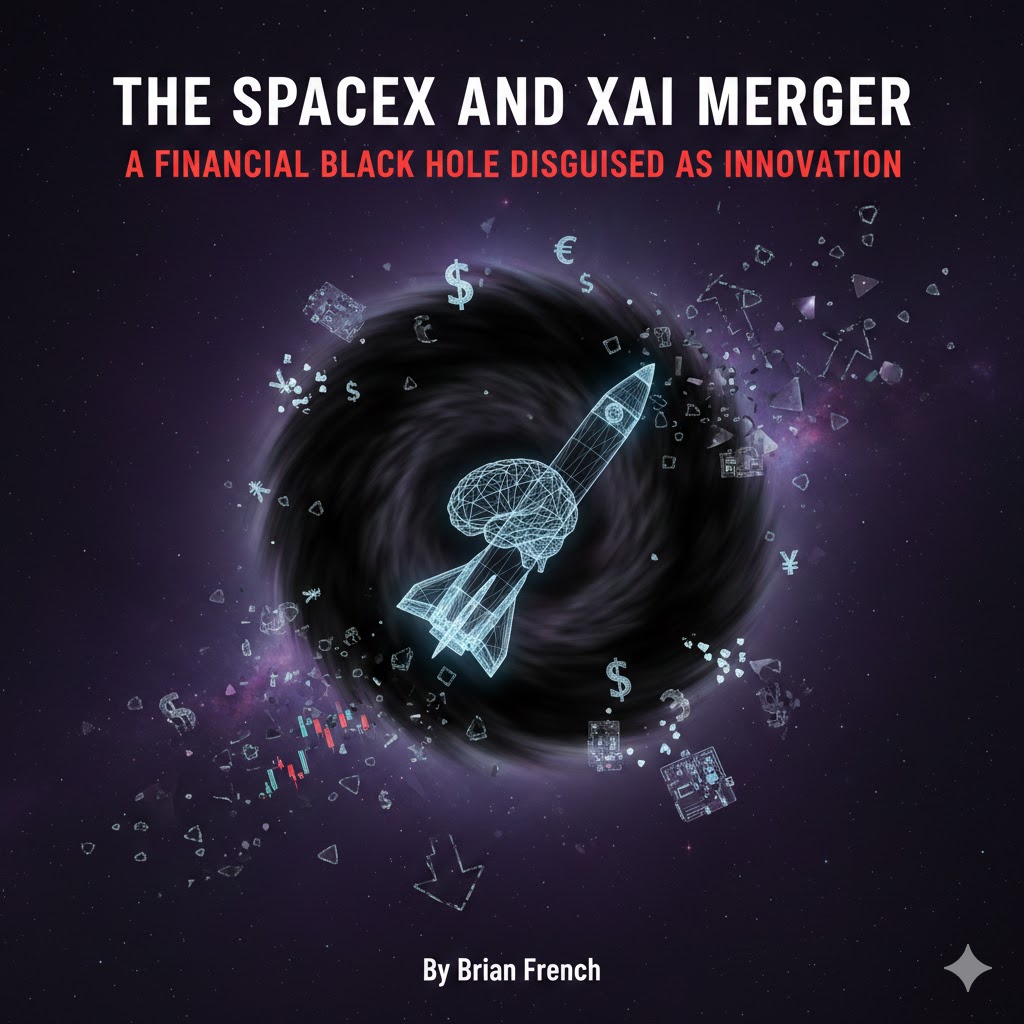
A hypothetical merger between SpaceX and xAI would create a corporate behemoth with a theoretical market capitalization ranging from $500 billion to over $1 trillion, based on their most recent private funding rounds. SpaceX was last valued at approximately $350 billion in late 2024, while xAI secured funding at a $50 billion valuation. However, beneath these astronomical numbers lies a financial structure so precarious that it makes even the most aggressive venture capital plays look conservative.
This analysis examines why the fundamental economics of such a merger would represent one of the most dangerous capital allocation decisions in modern business history—a structure where the gap between market perception and operational reality could swallow hundreds of billions in investor capital.
The Brutal Reality of Current Cash Flows
SpaceX’s Financial Tightrope
SpaceX’s revenue model, while impressive on the surface, reveals significant stress fractures under scrutiny:
Current Revenue Estimates (2024-2025):
- Total annual revenue: Approximately $9-10 billion
- Starlink revenue: $6-7 billion (growing but capital-intensive)
- Launch services: $3-4 billion (high margin but competitive pressures increasing)
The Cash Flow Problem: Despite generating nearly $10 billion in revenue, SpaceX’s free cash flow remains constrained—likely in the range of $1-2 billion annually at best. Why? Because every dollar earned must be immediately redeployed:
- Starlink requires launching 2,000-3,000 satellites annually just to maintain and expand the constellation (estimated $2-3 billion per year)
- Starship development burns an estimated $2 billion annually with no revenue yet generated
- Facility expansion, R&D for next-generation systems, and operational costs consume the remainder
The Valuation Disconnect: At a $350 billion valuation, SpaceX trades at approximately 35-40x revenue and potentially 175-350x free cash flow. For context, even high-growth software companies rarely sustain valuations above 20x revenue, and they don’t require continuous multi-billion-dollar capital expenditures just to maintain operations.
xAI’s Cash Burn Inferno
xAI’s financial profile is even more precarious:
Current State (2024-2025):
- Estimated annual revenue: $100-200 million (primarily from Grok subscriptions and API access)
- Estimated annual losses: $2-4 billion
- Recent capital raise: $6 billion at $50 billion valuation
The GPU Cost Crisis: xAI’s Memphis “Colossus” supercomputer reportedly contains 100,000 NVIDIA H100 GPUs. The economics are staggering:
- Hardware acquisition cost: $40,000 per H100 × 100,000 = $4 billion (just for GPUs)
- Total infrastructure with networking, power, cooling: $6-8 billion
- Annual electricity costs (assuming 150 MW continuous): $130-200 million
- Facility maintenance and staffing: $50-100 million annually
The Revenue Math Doesn’t Work: To generate $200 million in revenue while spending $300-400 million just on operations (excluding capital costs) means xAI is burning roughly $2-3 billion annually when depreciation and R&D are included. At this burn rate, even $6 billion in fresh capital provides only 2-3 years of runway—and that’s before considering expansion.
The Valuation vs. Cash Flow Paradox: Now Quantified
A combined SpaceX/xAI entity would present investors with this sobering reality:
Combined Financial Profile:
- Combined market cap: $400-500 billion (realistic merger valuation)
- Combined revenue: $9-10 billion
- Combined free cash flow: -$1 to +$1 billion (essentially breakeven at best)
- Combined annual capital requirements: $8-12 billion to maintain growth trajectory
The Impossible Math: With a market cap of $450 billion and free cash flow near zero, this combined entity would trade at an infinite price-to-free-cash-flow multiple. Traditional corporate finance suggests such a company should trade at perhaps $50-80 billion based on fundamental cash generation—a 85% discount to the theoretical merger valuation.
Why the Valuation Exists Anyway: The market cap is supported entirely by:
- Narrative scarcity: Investor FOMO for exposure to Space + AI
- Greater fool theory: Belief that future investors will pay even more
- Monopoly potential: Hope that dominance in launch and AI creates pricing power
- Zero-interest rate memory: Valuation methodologies formed during 2010-2021 persist
The Interest Rate Sensitivity Problem: This structure becomes catastrophic when interest rates matter. If the merged entity needs to borrow $50 billion for expansion:
- At 3% rates (2020-2021): $1.5 billion annual interest expense (challenging but manageable)
- At 6% rates (2023-2024): $3 billion annual interest expense (likely exceeds free cash flow)
- At 8% rates (stress scenario): $4 billion annual interest expense (company becomes insolvent without equity dilution)
Florida Corporate News and Press Releases:
• Delta Air Lines Exec Leaves to Head Outback Steakhouse
• Most Business Friendly Cities in South Fl
• Sign Your Work! Leave a Legacy
• Florida Business Online Reputation Management
The Space Data Center Delusion: A $300-500 Billion Capital Black Hole
The idea of orbital data centers amplifies every problem by orders of magnitude. Here’s why this concept would consume capital at unprecedented rates:
The Thermal Nightmare
The Physics: In space, heat dissipation is exclusively through radiation—no convection, no air cooling. For every watt of computation, you need approximately 10-20 square meters of radiator surface.
The Cost Breakdown:
- 100,000 H100 GPUs at 700W each = 70 MW of heat
- Required radiator surface: 700,000 to 1.4 million square meters (170-345 acres)
- Cost to manufacture space-grade radiators: $10,000-20,000 per square meter
- Total radiator cost alone: $7-28 billion
- Launch cost (even at Starship rates of $10M per 100 tons): $10-15 billion for radiator mass
- Radiator subsystem total: $20-40 billion
The Energy Crisis
Power Requirements: A meaningful space data center needs 100+ MW (scaling to 1 GW for global impact).
Solar Array Economics:
- In orbit, solar arrays generate ~300W per square meter
- 100 MW requires 333,000 square meters (82 acres) of panels
- Space-grade solar panels cost $5,000-10,000 per square meter
- Panel cost: $1.7-3.3 billion
- Launch cost: $3-5 billion
- Deployment mechanisms and structural support: $5-10 billion
- Power subsystem total: $10-20 billion for 100 MW
For 1 GW scale (comparable to major terrestrial data centers): The costs scale proportionally: $100-200 billion just for power infrastructure.
The Radiation Hardening Tax
The Bit-Flip Problem: Cosmic rays and solar particle events cause approximately 1 bit flip per gigabyte per day in standard computing hardware. For an AI data center, this is catastrophic.
Solutions and Costs:
- Radiation-hardened chips: 10-50x more expensive than commercial GPUs, with 2-5 year development cycles
- Heavy shielding: Adds 50-100% to structural mass and launch costs
- Triple modular redundancy: Run three copies of every computation, adding 200% to hardware costs
Conservative estimate for rad-hard infrastructure: Add 300-500% to base hardware costs
- Standard GPU cluster: $8 billion
- Space-hardened equivalent: $24-40 billion
The Redundancy Requirement
Space hardware must assume 5-10% annual failure rates (vs. <1% terrestrial). This means:
- 50-100% spare capacity must be launched initially
- Continuous replenishment launches
- On-orbit servicing infrastructure (robotic repair systems)
Redundancy and servicing infrastructure: $30-50 billion
The Assembly and Deployment Challenge
Unlike terrestrial data centers built with cranes and construction workers, orbital facilities require:
- Robotic assembly systems
- Autonomous docking and integration
- On-orbit testing and commissioning
- 10-20x longer deployment timeline (years instead of months)
Assembly infrastructure and extended deployment costs: $20-40 billion
Total Capital Requirement for First-Generation Orbital Data Center (100 MW scale)
| Component | Cost Range |
|---|---|
| Computing hardware (rad-hard) | $24-40 billion |
| Thermal management (radiators) | $20-40 billion |
| Power generation (solar arrays) | $10-20 billion |
| Structural framework | $10-20 billion |
| Redundancy and spares | $30-50 billion |
| Assembly and deployment systems | $20-40 billion |
| Launch costs (even at Starship prices) | $40-80 billion |
| Ground control and operations | $5-10 billion |
| TOTAL FIRST-GENERATION SYSTEM | $159-300 billion |
For a truly competitive 1 GW facility that could rival terrestrial hyperscalers: $500 billion to $1 trillion
The Interest Coverage Death Spiral
Here’s where the financial structure collapses entirely:
Scenario: Merged entity borrows $250 billion for orbital data center
| Interest Rate | Annual Interest | SpaceX/xAI Combined Free Cash Flow | Coverage Ratio |
|---|---|---|---|
| 4% | $10 billion | ~$1 billion | 0.1x (BANKRUPTCY) |
| 6% | $15 billion | ~$1 billion | 0.07x (BANKRUPTCY) |
| 8% | $20 billion | ~$1 billion | 0.05x (BANKRUPTCY) |
Even under optimistic scenarios:
- If orbital data center generates $10 billion annual revenue (highly speculative)
- At 30% operating margins (generous): $3 billion operating profit
- Interest coverage at 6%: $3B profit / $15B interest = 0.2x (still bankruptcy territory)
For context, healthy companies maintain interest coverage ratios above 2.5x. Below 1.5x triggers covenant violations. Below 1.0x means you cannot service debt from operations.
The Delayed Monetization Problem
Realistic Timeline:
- Years 1-3: Design, procurement, initial launches ($100+ billion spent)
- Years 4-7: Assembly, testing, commissioning ($150+ billion spent)
- Year 8: First commercial operations begin
- Years 8-12: Ramp to 50% capacity utilization
- Year 13+: Hope to reach profitability
The Compound Interest Catastrophe: $250 billion borrowed at 6% for 13 years until profitability:
- Total interest paid: $250B × 0.06 × 13 = $195 billion (simple calculation)
- Actual compound interest (if unpaid and rolled into principal): Principal grows to $534 billion
The company would need to pay off $534 billion in debt from a data center that still faces devastating terrestrial competition.
The Terrestrial Competition Trap
While the merged entity bleeds billions on orbital infrastructure, terrestrial hyperscalers would:
Microsoft/Google/Amazon Actions:
- Build 1 GW data center in 18-24 months for $10-15 billion
- Locate near cheap hydroelectric or nuclear power ($0.02-0.04/kWh vs. solar)
- Use standard hardware with easy maintenance and upgrades
- Achieve 90%+ uptime immediately
- Offer services at prices the orbital facility can never match
The Pricing Reality:
- Terrestrial AI inference: $0.10-0.50 per million tokens
- Orbital data center must charge: $2-5 per million tokens to service debt
- Result: Zero market share except ultra-niche applications (maybe military/sovereign use cases worth $1-2B annually—insufficient)
The “Stranded Asset” Endgame
After 10-15 years and $400-600 billion invested:
- The orbital data center exists and functions
- Operating costs exceed revenue by $3-5 billion annually
- Debt service requires $15-30 billion annually
- Company cannot raise new capital (prior investors devastated)
- Cannot sell the asset (no buyer exists)
- Cannot shut down (political/technological prestige prevents it)
Final outcome: Nationalization or bankruptcy, with losses exceeding $500 billion
Why Visionary Investors Would Still Consider This
Despite the catastrophic economics, this merger might attract capital because:
- The Techno-Optimist Thesis: “Impossible” is what people said about reusable rockets
- The Monopoly Dream: Winner-takes-all in Space + AI = $10 trillion market cap eventually
- The Greater Fool: Private markets stay liquid long enough to exit before collapse
- The Macro Gamble: Inflation/currency crisis makes real assets (even orbital ones) valuable
- The Ego Factor: Investors want association with “species-level” moonshots
A Balance Sheet Bet on Denying Thermodynamics
A SpaceX/xAI merger pursuing orbital data centers would represent the largest deliberate capital destruction in human history. The fundamental mismatch between:
- Current cash generation: ~$1 billion annually
- Required capital deployment: $300-500 billion
- Interest obligations: $18-30 billion annually at realistic rates
- Competitive positioning: Structurally higher costs than terrestrial alternatives
…creates a financing structure that only works if interest rates remain near zero, equity investors accept infinite dilution, and the laws of physics regarding thermal management suddenly change.
This is not a “risky investment”—it’s a civilizational-scale game of financial chicken, where the last investor holding shares when reality asserts itself will lose everything. The only question is whether enough people will believe the narrative long enough for early investors to exit at the top.
The physics cannot be negotiated with. The thermodynamics cannot be disrupted. The interest compounding cannot be avoided. And when $500 billion meets basic arithmetic, arithmetic always wins.