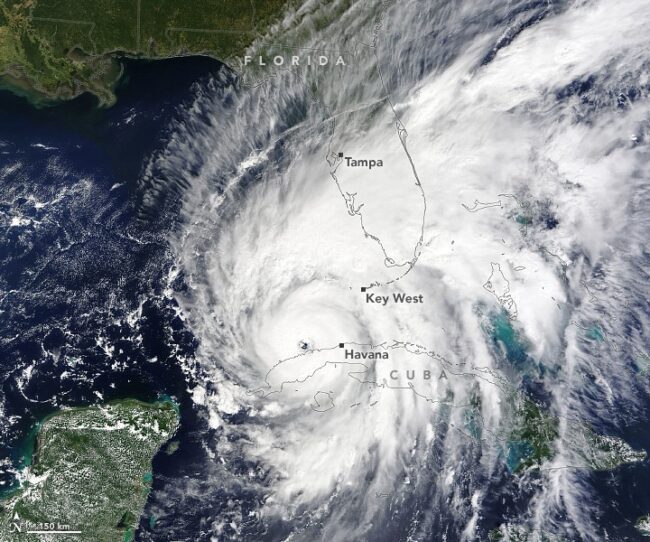
Photo: NASA Earth Observatory image by Lauren Dauphin, using MODIS data from NASA EOSDIS LANCE and GIBS/Worldview. Public domain.
Quick Answer: Fort Lauderdale-based Universal Insurance Holdings (NYSE: UVE) earned $52.5 million, or $1.80 per diluted share, in the third quarter of 2026, up from $39.8 million, or $1.38, a year earlier. Revenue rose 9.6% to $439.3 million and the net combined ratio improved to 91.0% from 96.4%. Florida direct premiums written slipped 3.3% as rates fell, while business in other states grew 18.5%.
Universal Insurance Holdings, a Fort Lauderdale-based homeowners insurer whose business is concentrated in Florida, reported its third-quarter 2026 results on October 22, 2026, and filed its quarterly report with the Securities and Exchange Commission shortly afterward. The numbers show a company earning more on every premium dollar it keeps, buying cheaper reinsurance protection and growing its policy count, even as it cuts rates in its home state.
That combination tells a broader story about Florida’s property insurance market. Four years after lawmakers overhauled the state’s insurance laws in December 2022, the market that once drove carriers into insolvency is now crowded with competitors, rates are drifting lower and the state-backed insurer of last resort has shrunk dramatically.
How much did Universal Insurance earn in the third quarter of 2026?
Net income available to common shareholders rose 31.8% to $52.5 million for the quarter ended September 30, 2026, compared with $39.8 million in the third quarter of 2025. Diluted earnings per share climbed 30.4% to $1.80 from $1.38.
On an adjusted basis, which excludes investment gains and losses, net income rose 43.9% to $56.3 million and adjusted diluted earnings per share reached $1.93, up 41.9% from $1.36. The gap largely reflects a $6.0 million unfavorable change in unrealized investment gains.
Total revenue grew 9.6% to $439.3 million from $401.0 million. Net premiums earned, the company’s core revenue line, rose 12.1% to $403.2 million. Net investment income increased to $21.5 million from $18.3 million, which the company attributed to a larger invested asset base and higher reinvestment yields on fixed-income securities.
Annualized return on common equity was 32.7% in the quarter, compared with 33.4% a year earlier. Chairman and Chief Executive Officer Stephen J. Donaghy said in the release that the company “delivered a very strong 32.7% annualized return on common equity.”
| Metric | Q3 2026 | Q3 2025 | Change |
|---|---|---|---|
| Total revenue | $439.3 million | $401.0 million | +9.6% |
| Net premiums earned | $403.2 million | $359.7 million | +12.1% |
| Net income to common | $52.5 million | $39.8 million | +31.8% |
| Diluted EPS | $1.80 | $1.38 | +30.4% |
| Adjusted diluted EPS | $1.93 | $1.36 | +41.9% |
| Net investment income | $21.5 million | $18.3 million | +17.1% |
| Annualized return on common equity | 32.7% | 33.4% | -0.7 pts |
Source: Universal Insurance Holdings third-quarter 2026 earnings release (Form 8-K, Exhibit 99.1).
How did the first nine months of 2026 compare?
Year-to-date results were stronger still. For the nine months, net income available to common shareholders rose 42.7% to $166.0 million and diluted earnings per share increased 42.2% to $5.73 from $4.03. Adjusted diluted EPS reached $5.78, up 43.8%. Total revenue rose 5.3% to $1.26 billion, and the annualized return on common equity was 37.0%, compared with 35.7% in the first nine months of 2025.
What were Universal’s loss and combined ratios?
The underwriting picture improved sharply. The net loss ratio fell 5.6 percentage points to 64.6% from 70.2%, while the net expense ratio edged up to 26.4% from 26.2%. Together, the net combined ratio improved to 91.0% from 96.4%.
According to the 10-Q, the lower loss ratio was primarily attributable to a lower ceded premium ratio, meaning the company kept more of its premium after paying for reinsurance. The quarter also carried no net prior-year reserve development, compared with $3.9 million a year earlier, and no catastrophe losses from new events in either period. Weather-related losses were higher than in the prior-year quarter but within management’s estimated range, the filing said. The slightly higher expense ratio reflected higher acquisition and operating expenses.
| Net ratio | Q3 2026 | Q3 2025 | 9M 2026 / 9M 2025 |
|---|---|---|---|
| Loss ratio | 64.6% | 70.2% | 64.5% / 71.0% |
| Expense ratio | 26.4% | 26.2% | 26.3% / 25.4% |
| Combined ratio | 91.0% | 96.4% | 90.8% / 96.4% |
| Ceded premium ratio | 27.6% | 32.7% | 30.3% / 31.5% |
Source: Universal Insurance Holdings third-quarter 2026 earnings release and Form 10-Q.
How many policies does Universal have in Florida and other states?
Universal had 953,611 policies in force at September 30, 2026, up 7.9% from 883,888 a year earlier. Premiums in force rose 4.4% to $2.23 billion, and total insured value increased to about $429.6 billion from $385.0 billion.
Florida remains the core of the business. The state accounted for 598,104 policies, or about 63% of the total, and $1.57 billion, or roughly 70%, of premiums in force. Florida policy counts grew about 6.5% from 561,546 a year earlier, but Florida premiums in force were essentially flat, slipping slightly from $1.572 billion. That means the average Florida premium per policy fell to roughly $2,620 from about $2,800, a calculation based on the company’s reported figures that reflects the rate cuts Universal has taken in the state.
Outside Florida, growth came from both policies and price. Policies in other states rose about 10.3% to 355,507, and premiums in force there climbed about 17.4% to $661.3 million. Insured value in other states, at $231.2 billion, now exceeds Florida’s $198.4 billion.
| As of Sept. 30 | Florida 2026 (2025) | Other states 2026 (2025) | Total 2026 (2025) |
|---|---|---|---|
| Policies in force | 598,104 (561,546) | 355,507 (322,342) | 953,611 (883,888) |
| Premiums in force | $1.568B ($1.572B) | $661.3M ($563.0M) | $2.229B ($2.135B) |
| Q3 direct premiums written | $414.4M ($428.6M) | $194.5M ($164.1M) | $608.9M ($592.8M) |
| Total insured value | $198.4B ($185.0B) | $231.2B ($200.0B) | $429.6B ($385.0B) |
Source: Universal Insurance Holdings third-quarter 2026 earnings release.
Why did Florida premiums decline while policies grew?
Direct premiums written totaled $608.9 million in the quarter, up 2.7%. Florida fell $14.2 million, or 3.3%, to $414.4 million, while other states rose 18.5% to $194.5 million. Florida’s share of quarterly written premium dropped to about 68% from about 72% a year earlier.
The 10-Q explains why. Universal’s Florida subsidiaries implemented an average rate decrease of 5.1% effective October 16, 2025, and the filing describes a further average decrease of 5.0% with an effective date of October 16, 2026, pending regulatory approval. The company says it has reduced rates for three consecutive years. It also launched targeted commission incentives in 2026 for appointed agencies to compete for new business.
Outside Florida, Universal is moving the other way. The 10-Q lists approved 2026 rate increases across 12 states, ranging from 4.6% in Maryland to 39.9% in Wisconsin, plus pending requests in New Hampshire, Virginia, Maryland and Michigan. The company writes its primary product in 19 states and is authorized in Tennessee, where a rate filing is underway.
What does Universal’s reinsurance program look like for 2026-2027?
Reinsurance is a central expense for any Florida homeowners insurer, and it was a major driver of this quarter’s results. Universal’s subsidiaries, Universal Property & Casualty Insurance Company and American Platinum Property and Casualty Insurance Company, completed their 2026-2027 program in late May, with coverage effective June 1, 2026.
The program tops out at $2.623 billion for a single event, about $50 million higher than the prior treaty year, with a combined first-event retention of $45 million, unchanged from the year before. The company secured first and subsequent event capacity and added $352 million of multi-year catastrophe protection with agreed limits extending into the 2027-2028 treaty period, including $277 million that sits below the Florida Hurricane Catastrophe Fund layer. The largest private participants include Nephila Capital/Markel, RenaissanceRe, Munich Re, Chubb Tempest Re, Ariel Re, Everest Re and Lloyd’s syndicates. Chief Risk Officer Matthew J. Palmieri said the company secured capacity “at efficient pricing.”
The financial effect showed up quickly. Ceded premiums earned fell 12.0% to $153.5 million in the quarter, and the ceded premium ratio dropped to 27.6% from 32.7%. The new program did trim commission and fee income, which fell 10.8% to $19.6 million.
How did Hurricane Isaias affect Universal?
The storm arrived after the quarter closed. According to the 10-Q, Hurricane Isaias made landfall in the Florida Panhandle on October 9, 2026, as a Category 2 storm near Destin before weakening inland. Because it occurred after September 30, no related reserves were recorded in third-quarter results.
The company’s preliminary estimate is that losses will exceed its $45 million per-occurrence retention but may remain below its $111 million consolidated catastrophe retention, which includes up to $66 million of coverage provided by a captive entity. The filing states that ultimate gross and net losses cannot yet be reasonably estimated, and the financial effects are expected in the fourth quarter. Donaghy said claims activity so far “has been less significant than initially anticipated.”
How is Universal returning capital to shareholders?
Universal repurchased about 174,000 shares during the third quarter for about $7.4 million, leaving roughly $1.1 million on its authorization at quarter end. On October 29, 2026, the board authorized repurchases of an additional $20.0 million, according to the 10-Q. The company also paid its regular quarterly dividend of $0.16 per share on August 7, 2026, matching the prior-year rate.
The balance sheet strengthened over the year. Stockholders’ equity rose to $646.0 million from $551.0 million at the end of 2025, book value per share climbed 32.4% year over year to $23.37, and adjusted book value per share rose 38.2% to $25.90. Cash and equivalents increased to $569.5 million, while debt stood at $97.3 million. The primary Florida subsidiary, Universal Property & Casualty, reported statutory capital and surplus of $510.2 million.
Did Universal provide guidance?
No. The earnings release did not include a financial outlook for the fourth quarter or for 2027. Key open items include the final Isaias loss figure and the pending Florida rate decision.
| Company snapshot | Detail |
|---|---|
| Company | Universal Insurance Holdings, Inc. (NYSE: UVE) |
| Headquarters | 1110 W. Commercial Blvd., Fort Lauderdale, Broward County |
| Insurance subsidiaries | Universal Property & Casualty Insurance Co.; American Platinum Property and Casualty Insurance Co. |
| Footprint | Primary product written in 19 states; Florida is the majority of policies |
| Primary regulator | Florida Office of Insurance Regulation |
| Leadership | Stephen J. Donaghy, Chairman and CEO |
| Total assets (Sept. 30, 2026) | $3.18 billion |
Source: Universal Insurance Holdings Form 10-Q, earnings release and reinsurance announcement.
What does Universal’s quarter say about Florida’s homeowners insurance market?
Universal’s own filing frames the market change plainly. The 10-Q says a series of legislative changes enacted in December 2022 addressed prior market disruption, and that the Florida residential property market has steadily improved since, with moderating rates, more product availability, more competition and a substantial reduction in policies at Citizens Property Insurance Corp. The company notes that approximately 20 new insurers have entered Florida in recent years.
State data point the same way. In September 2026, the Florida Office of Insurance Regulation announced approved rate decreases of 3.2% to 10.4% for four more insurers, according to Florida Realtors. Since January 2024, 48 companies have filed for rate decreases and 53 have requested no change. OIR also cited S&P Global figures showing Florida was the only state with an average homeowners rate decrease in 2025, at 0.92%, against a national weighted average increase of 5.5%. The average admitted-market homeowners premium, including wind, was $3,736.
Citizens has shrunk to roughly 255,000 policies as of mid-September 2026 from about 1.4 million in September 2023, with total insured value down to about $70 billion from $552 billion. Citizens projects about 248,000 policies by year-end, and its president has credited legislative changes targeting litigation costs for the turnaround.
For a carrier like Universal, that environment cuts two ways. Lower litigation pressure, cited by Citizens, and a lower ceded premium ratio have supported a combined ratio near 91% and a return on equity above 30%. But more competition and falling rates are squeezing Florida premium per policy, which is why the company is leaning on growth in other states, where premiums in force rose about 17%. For Broward County, home to Universal’s headquarters, and for Florida homeowners more broadly, the results suggest the private market has regained enough footing to compete on price rather than retreat.
Frequently Asked Questions
What were Universal Insurance Holdings’ third-quarter 2026 earnings?
Net income available to common shareholders was $52.5 million, or $1.80 per diluted share, compared with $39.8 million, or $1.38, a year earlier. Adjusted diluted EPS was $1.93.
What was Universal’s combined ratio in the third quarter?
The net combined ratio was 91.0%, improved from 96.4%, driven by a lower net loss ratio of 64.6% that was partly offset by a slightly higher 26.4% expense ratio.
How many policies does Universal insure?
Universal had 953,611 policies in force at September 30, 2026, including 598,104 in Florida and 355,507 in other states, with $2.23 billion of premiums in force.
Is Universal cutting homeowners rates in Florida?
Yes. The company took an average 5.1% decrease effective October 16, 2025, and its 10-Q describes a further average 5.0% decrease effective October 16, 2026, pending regulatory approval.
How much will Hurricane Isaias cost Universal?
No final figure is available. The company expects losses to exceed its $45 million retention but possibly stay below its $111 million consolidated catastrophe retention, with effects in the fourth quarter.
Where is Universal Insurance Holdings based?
The company is headquartered at 1110 W. Commercial Blvd. in Fort Lauderdale and writes its primary product in 19 states, with Florida making up the majority of its policies.
Sources and Further Reading
- Universal Reports Third Quarter 2026 Results (Form 8-K, Exhibit 99.1) — U.S. Securities and Exchange Commission
- Universal Insurance Holdings Form 10-Q for the Quarter Ended September 30, 2026 — U.S. Securities and Exchange Commission
- Universal’s Insurance Subsidiaries Complete 2026-2027 Reinsurance Program (Form 8-K, Exhibit 99.1) — U.S. Securities and Exchange Commission
- Universal’s Q3’26 revenues rise 9.6% to $439m — Reinsurance News
- Florida Approves More Home Insurance Rate Cuts — Florida Realtors
About Brian French
Led by a commitment to tech-intelligent curation, Brian French tracks and analyzes the corporate developments defining Florida's economy. Brian brings an extensive financial background to his analysis, having graduated from the University of South Florida in Finance and serving as a Vice President and Portfolio Manager for Merrill Lynch Private Investors and the Trust Department in St. Petersburg, FL, as well as a Vice President and Trust Investment Officer for SunTrust Bank in Sarasota, FL. His writing blends macroeconomic trends, fiduciary capital markets, corporate strategy, and modern digital insights for a sophisticated look at Florida's business market.