By Brian French | March 4, 2026
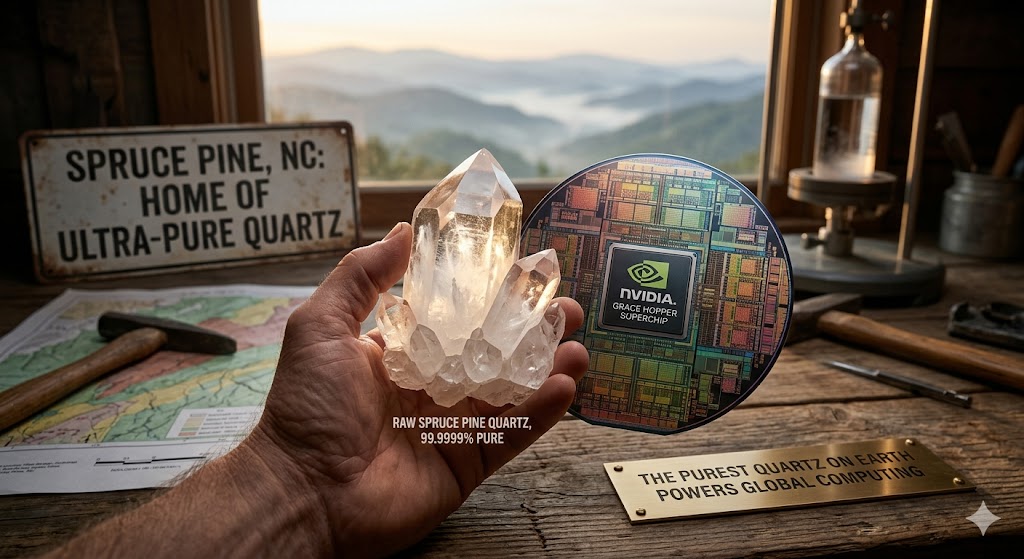
You’ve never heard of Spruce Pine, North Carolina. But every smartphone you’ve ever touched, every AI model you’ve ever used, every solar panel on every rooftop — all of it began with grains of extraordinarily pure quartz dug out of the Blue Ridge Mountains in this little Appalachian town of 2,000 people.
A Geological Accident 380 Million Years in the Making
Picture the Earth as it looked before dinosaurs, before flowers, before fish had fully committed to walking on land. Two ancient supercontinents — proto-North America and proto-Africa — were grinding toward each other at the geological equivalent of a slow-motion train wreck. The collision built the Appalachian Mountains, which were once as tall as the Himalayas. But the real gift happened deep underground.
Miles beneath the surface, the friction and heat of colliding continents melted rock into a rich mineral-forming liquid. Critically — and this is the lucky part — there was almost no water in the zone where all this happened. Water, you see, is an impurity delivery system. It carries iron, aluminum, titanium, and dozens of other contaminants that would ruin a crystal’s purity. Without water, the molten quartz cooled and crystallized over millions of years into something that geologists still struggle to fully explain: deposits of silicon dioxide so pure that most of the world’s other quartz deposits can’t even come close.
The result is what one geologist called “the purest natural quartz ever found on Earth.” And it’s sitting in a valley in Mitchell County, North Carolina, population 15,000.
“It is rare, unheard of almost, for a single site to control the global supply of a crucial material.” — Ed Conway, author of Material World (2023)
By the Numbers
| Stat | Figure |
|---|---|
| Share of world’s ultra-pure quartz from Spruce Pine | 70–90% |
| Maximum silicon purity achievable | 99.99999999999% (eleven nines) |
| Age of the deposit | ~380 million years |
| Total investment to expand capacity | $700 million |
| Estimated mine life remaining | 100+ years |
From Mountain to Microchip: The Incredible Journey
Here’s the thing most people don’t appreciate: the silicon in your phone’s chip didn’t start as beach sand. Making a modern semiconductor requires quartz so pure it would make a diamond blush. And getting there involves one of the most extraordinary purification journeys in all of industry.
Step 1 — Mining in the Blue Ridge: Crews extract pegmatite rock from open-pit mines along Fish Hatchery Road. The quartz is already remarkably pure — but “remarkably” isn’t good enough yet.
Step 2 — Froth flotation and milling: The rock is crushed and run through multiple rounds of chemical flotation to strip away feldspar, mica, and iron. The result: fine white IOTA® quartz sand.
Step 3 — Acid leaching (the secret weapon): Spruce Pine’s open crystalline structure allows hydrofluoric acid to penetrate directly into the crystal lattice to dissolve lingering traces of contamination — something almost no other quartz on Earth permits. This step is what makes Spruce Pine irreplaceable. Geologists have evaluated thousands of quartz samples from around the world, and nearly all of them have contaminant locked inside the crystal structure that simply cannot be extracted. Spruce Pine’s is different.
Step 4 — Chlorine and heat treatment: High-temperature reactions with chlorine or hydrochloric acid push purity into rarefied territory — parts per billion of contamination, not parts per million.
Step 5 — Fused quartz crucibles: The purified sand is melted into fused quartz and shaped into crucibles — bowls that will hold molten silicon at 1,425°C (2,597°F) during the Czochralski crystal-growing process. Any impurity in the crucible leaches into the silicon. Which is why it has to be perfect.
The Czochralski Process: Where Quartz Becomes Computing
In the 1950s, a Polish chemist named Jan Czochralski accidentally dipped his pen into molten tin instead of his inkwell and pulled out a perfect single crystal. The industrial process bearing his name — called CZ for short — is now the backbone of all semiconductor manufacturing.
Here’s how it works: polysilicon (silicon refined to 99.999999999% purity — eleven nines, in the industry’s dramatic shorthand) is loaded into a fused quartz crucible. The silicon melts. A tiny “seed crystal” is dipped into the melt and then slowly rotated and pulled upward. Atom by atom, the silicon arranges itself into a perfect cylindrical single crystal called an ingot — up to 300mm wide and over a meter tall. That ingot is then sliced into thin wafers, polished to atomic smoothness, and handed off to chip fabs like TSMC and Intel, where circuits are etched onto them at nanometer scales.
The crucible — Spruce Pine’s gift to the process — is both essential and single-use. After about 400 hours of operation, it degrades and must be replaced. Each one costs thousands of dollars. Crucibles account for roughly 30% of the manufacturing cost of a silicon ingot. Do the math across thousands of furnaces running 24/7 around the world, and you’re looking at a market that runs into the billions annually.
A close call: When Hurricane Helene slammed into western North Carolina in September 2024, it dropped over 24 inches of rain in 24 hours, flooding mines and halting operations at both Sibelco and The Quartz Corp. Global chip markets held their breath. Industry analysts warned that if the shutdown lasted more than three months, semiconductor production could be affected worldwide. The mines came back online within weeks — but the world had just glimpsed how precarious its digital infrastructure truly is.
A Single Point of Failure — and Why That’s Changing
Academics and industry analysts use a specific, slightly terrifying term for Spruce Pine: a “single point of failure.” The semiconductor supply chain — which underpins AI, smartphones, defense systems, medical devices, and the entire digital economy — runs through two mines on a two-lane rural highway in the Appalachian Mountains.
China, for all its industrial ambitions, produces only around 5,000 tons of high-purity quartz annually, a fraction of what Spruce Pine outputs, and lacks comparable deposits. Russia and Brazil have some quartz reserves but nothing that approaches Spruce Pine’s combination of purity, volume, and that crucial open crystalline structure that permits deep acid purification. Synthetic quartz can be made even purer than the natural stuff, but it costs 5 to 10 times more — perfectly manageable for chip makers, but economically devastating for the solar panel industry.
The good news? The people running Spruce Pine know exactly how important it is, and they’re acting accordingly.
Sibelco, the Belgian mining company that operates the largest Spruce Pine mines, has committed a staggering $700 million in expansion — $200 million in a first phase to double capacity by 2025, followed by a $500 million second phase running through 2027. Mine life projections suggest the deposits can sustain production for over 100 more years. North Carolina lawmakers, meanwhile, passed legislation in 2024 to ban Chinese or Russian ownership of quartz mines in the state. America is waking up to what it has.
“An estimated three-quarters of Spruce Pine has a direct connection to the mines — through a job, a job that relies on the mines, or a family member who works there.” — Spruce Pine town council member, October 2024
Edison Knew First
This story goes back further than most people realize. Thomas Edison needed an insulator for his electrical inventions in 1879, and he found it in Spruce Pine mica. The same valley that supplied Edison has been quietly feeding every technological revolution since — vacuum tubes, early transistors, the integrated circuit boom, the internet era, and now the AI age.
The connection between this sleepy mountain town and the most advanced technology on Earth is genuinely poetic. While Silicon Valley gets the glamour and Taiwan’s TSMC gets the headlines, there’s a two-lane road in North Carolina where a pickup truck drives past a mountain and heads to a processing plant, and in the back of that truck is material that will eventually become the chip running the AI model that writes the press release for the company that just IPO’d on NASDAQ. It’s all connected. It’s always been connected.
The AI Boom Changes Everything
Before AI entered its current explosive phase, the semiconductor industry was already the engine of the global economy. The AI buildout has thrown fuel on that engine. Data centers are consuming silicon wafers at a rate that has surprised even the most bullish analysts. NVIDIA’s GPU demand, the proliferation of custom AI chips from Google, Amazon, Apple, and Meta, and the race to build AI inference infrastructure at scale — all of it requires more ingots, more wafers, more crucibles, more Spruce Pine quartz.
Sibelco increased high-purity quartz production by over 70% between 2019 and 2023 alone. And demand shows no signs of slowing. Meanwhile, the CHIPS and Science Act — which committed over $52 billion to rebuild American semiconductor manufacturing — is creating new domestic demand for exactly what Spruce Pine produces. Every new fab Intel builds in Ohio, every TSMC plant going up in Arizona, every Samsung expansion in Texas — they all need crucibles. They all need Spruce Pine.
The Optimist’s Take: America Holds a Royal Flush
There’s a tendency, especially in tech discourse, to focus on American vulnerabilities — our dependence on Taiwanese chip fabs, our lagging battery supply chains, our exposure to Chinese rare earth exports. Those concerns are real and worth addressing. But let’s spend a moment appreciating what America actually has.
We have the purest quartz deposit on Earth, and it’s in North Carolina. We have decades of mining expertise, a trained local workforce, an expanding production base, and a legislative environment that recognizes this material’s strategic importance. We have 100-plus years of known reserves sitting in the Blue Ridge Mountains. And we’re investing $700 million to extract and process it better than ever before.
Saudi Arabia has oil. The Congo has cobalt. Australia has lithium. America has Fish Hatchery Road in Spruce Pine, North Carolina — and what comes out of the ground there is arguably more indispensable to the 21st century economy than any of those other resources. You can run an economy without oil eventually. You cannot, today, run a semiconductor industry without ultra-pure quartz, and there is nowhere on Earth that does it like Spruce Pine.
The next time you unlock your phone with your face, or ask an AI assistant something, or watch a solar farm gleaming in the sun — think about a mountain in the Blue Ridge, 380 million years of geological patience, and a little town you’d never heard of until right now.
Spruce Pine is not just a mining story. It’s the story of a natural miracle embedded in American soil, waiting for the world to catch up to its importance. The world has caught up. And the mountain isn’t going anywhere.