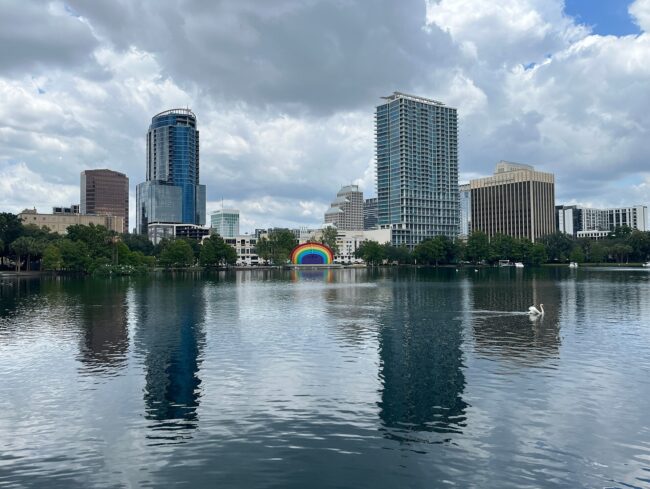
Downtown Orlando and Lake Eola. Photo: Benoît Prieur via Wikimedia Commons. License: CC0.
Quick Answer: Orlando-based Hilton Grand Vacations reported third quarter 2026 contract sales of $807 million, down 11.0% from a year earlier, as sales teams converted fewer tours into purchases. Headline revenue jumped to $1.961 billion only because a finished Hawaii project released $536 million of previously deferred sales, and the company cut its full-year 2026 adjusted EBITDA guidance to $1.165 billion to $1.180 billion.
Hilton Grand Vacations Inc. (NYSE: HGV), the timeshare company headquartered in Orlando, closed its third quarter of 2026 with two very different stories in one set of numbers. On the reported line, revenue rose 51% and earnings per share jumped more than thirteenfold. Underneath, the core selling machine slowed: contract sales fell 11.0%, volume per guest dropped 12.5%, and management lowered its full-year profit outlook to a range that sits entirely below the bottom of the old one.
The results, released October 29, 2026, matter to Florida because HGV is one of the largest hospitality employers and corporate headquarters in Central Florida, and its owned Bluegreen business runs a major Orlando sales operation. What follows breaks down what happened, why it happened, and which numbers Florida business readers should track into 2027.
What did Hilton Grand Vacations report for the third quarter of 2026?
For the quarter ended September 30, 2026, HGV reported total revenues of $1.961 billion, compared with $1.300 billion in the third quarter of 2025. Net income attributable to stockholders was $291 million, or $3.70 per diluted share, compared with $25 million, or $0.28 per share, a year earlier. Adjusted net income attributable to stockholders was $317 million, or $4.03 per diluted share.
Adjusted EBITDA attributable to stockholders reached $609 million, compared with $245 million in the prior-year quarter. Every one of those headline figures, however, was lifted by a single accounting event tied to construction in Hawaii.
Why did revenue surge while sales fell?
Under the revenue accounting standard known as ASC 606, HGV defers the revenue and direct costs of timeshare sales at projects still under construction until the building is complete. In the third quarter, the company received completion on its Ka Haku project, a Hilton Club in Waikiki. That triggered a net recognition of $536 million in sales of vacation ownership interests, with a net construction recognition of $296 million at the earnings level, equal to $3.76 per diluted share.
In other words, more than the entire reported diluted EPS of $3.70 came from recognizing sales booked in earlier periods. In the third quarter of 2025, by contrast, HGV had a net construction deferral of $57 million related to projects under construction in Hawaii and Japan, which depressed that year’s reported profit.
Management’s own comparable measure strips these effects out. On the earnings call, the company said adjusted EBITDA excluding the recognition was $313 million, up 4% from a year earlier, with a margin of 25% excluding cost reimbursements, up 80 basis points.
Key figures at a glance
| Metric (Q3) | 2026 | 2025 | Change |
|---|---|---|---|
| Total revenues | $1.961B | $1.300B | +50.8% |
| Contract sales | $807M | $907M | -11.0% |
| Tour flow | 235,991 | 232,035 | +1.7% |
| Volume per guest (VPG) | $3,406 | $3,891 | -12.5% |
| Net income to stockholders | $291M | $25M | n/m |
| Diluted EPS | $3.70 | $0.28 | n/m |
| Adj. EBITDA to stockholders (reported) | $609M | $245M | +148.6% |
| Adj. EBITDA excl. construction effects | $313M | $302M | +3.6% |
| Free cash flow | $52M | -$4M | n/m |
Source: Hilton Grand Vacations third quarter 2026 earnings release. Excluding-construction EBITDA for 2025 is the reported $245 million plus the $57 million net construction deferral; percentage changes calculated by Florida Authority Network™.
Why did HGV’s contract sales fall 11%?
Contract sales, the dollar value of timeshare purchase agreements signed with at least a 10% down payment, are the clearest gauge of how the sales engine is running. They fell by $100 million to $807 million. On the previous call, management had expected a mid-single-digit decline.
The problem was not traffic. Tour flow, the number of sales presentations delivered, rose 1.7% to 235,991. What fell was the amount of business closed per tour. Volume per guest, which combines average transaction price with closing rate, dropped from $3,891 to $3,406.
CEO Mark Wang was direct about it in the earnings release: “our sales results fell short of our expectations as the initiatives we put in place over the summer to improve execution are taking longer to ramp than we anticipated.” On the call he added, “To be clear, we’re not satisfied with this outcome,” and, “we don’t see this as an issue of willingness to travel.”
What went wrong on the sales floor?
According to the earnings call transcript, management pointed to closing rates as the core issue and tied conversion softness to incentive alignment and what Wang called a “more dynamic headcount environment” that required new recruiting and retention programs. Wang said the company hired more than 430 experienced new salespeople over four months, plus 350 with real estate experience, and that 165 of those were former HGV representatives. Sales staff turnover ran above historical norms before stabilizing late in the quarter.
Management described August as the low point. Several key sales centers returned to positive growth in September, and that improvement continued into October. Wang also said consumer pressure was having “marginally more impact” on purchase decisions than a quarter earlier.
The company also faced a known comparison problem. Sales of the Bluegreen version of its HGV Max membership program launched a year earlier and created difficult year-over-year comparisons, which management said it anticipated.
What happened at the Bluegreen Orlando operation?
The call offered one Florida-specific data point. Wang said the Bluegreen Orlando property received a new leader, rebuilt its team, and returned to growth in September. HGV acquired Bluegreen Vacations and now owns 51% of Bluegreen/Big Cedar Vacations, according to the release’s definitions of its noncontrolling interest. Bluegreen had the steepest decline among the company’s brands in the quarter because of the Max comparison.
How did HGV’s other business lines perform?
Outside of new sales, the company’s recurring businesses held up. That matters because the timeshare model earns money three ways: selling ownership, financing those purchases, and managing the resorts and clubs afterward.
| Business line (Q3) | 2026 profit | 2025 profit | 2026 margin |
|---|---|---|---|
| Financing | $94M | $75M | 63.1% |
| Resort and club management | $136M | $135M | 69.4% |
| Rental and ancillary services | -$7M | -$4M | -3.6% |
| Real estate (reported, incl. Ka Haku) | $478M | $121M | 40.5% |
Source: Hilton Grand Vacations Q3 2026 earnings release, tables T-8 through T-11.
Is the financing business still growing?
Yes. Financing revenue rose $21 million to $149 million, driven by a larger average balance of timeshare loans and $4 million less premium amortization on acquired receivables. Financing profit increased to $94 million from $75 million. Net timeshare financing receivables on the balance sheet grew to $3.676 billion at September 30, 2026, from $3.115 billion at the end of 2025. On the call, management said the weighted average interest rate on newly originated loans was 14.2%.
How stable is the membership base?
Resort Operations and Club Management segment revenue rose $10 million to $416 million. HGV ended the quarter with 715,888 club members, compared with 721,488 a year earlier, a decline of less than 1%. Resort and club management profit margin was 69.4%, nearly unchanged from 69.9%.
What changed in HGV’s loan-loss accounting?
The provision for financing receivable losses fell to 12.5% of owned contract sales, from 16.8% a year earlier according to the call. The release attributes the decline primarily to a change in its allowance methodology. HGV combined the historical performance of receivables from the businesses it acquired into a single static pool that stratifies loans by FICO score and equity percentage at the time of sale. The change was accounted for prospectively as a change in estimate and produced a $55 million decrease in the allowance, which reduced the provision and increased reported sales of vacation ownership interests.
Chief Financial Officer Daniel Mathewes said on the call that under the old methodology the provision rate would have been roughly 20%, and just under 18% under the new method before the one-time adjustment. He said the company expects the long-term provision to center in the mid-teens. Management also said delinquencies were stable from the prior quarter and lower than at year-end, and that Bluegreen’s 31-to-60-day delinquencies in early October were at 2022 levels.
What is HGV’s new 2026 guidance?
HGV lowered its full-year 2026 adjusted EBITDA guidance, excluding construction deferrals and recognitions, to $1.165 billion to $1.180 billion from $1.225 billion to $1.265 billion. At the midpoints, that is a cut of about $72.5 million, or roughly 5.8%.
On the call, management said it expects full-year contract sales to fall by a mid-single-digit percentage, with fourth quarter contract sales down low-to-mid single digits. Wang said sales for the rest of the quarter were expected “in that low to mid-single digits, in line with what we saw in October.” Management also said fourth quarter arrivals and first-half 2027 arrivals were tracking ahead of the prior year.
Nine-month figures show the scale of the slowdown. Contract sales for the first nine months of 2026 were $2.336 billion, compared with $2.462 billion in 2025, a decline of about 5.1%.
How strong is HGV’s balance sheet?
As of September 30, 2026, HGV had $227 million of unrestricted cash, $275 million of restricted cash, and $457 million of remaining capacity under its revolving credit facility, for total liquidity of about $684 million. It also had $450 million of remaining capacity under its Timeshare Facility and $175 million under its Big Cedar Timeshare Facility.
| Balance sheet item (Sept. 30, 2026) | Amount |
|---|---|
| Corporate debt, net | $4.9B at 5.751% weighted average |
| Non-recourse debt, net | $2.9B at 5.054% weighted average |
| Total net leverage (trailing 12 months) | About 3.9x |
| Unsecuritized notes, current on payments | $1.3B |
| Inventory | $2.388B |
| Total assets | $11.805B |
Source: Hilton Grand Vacations Q3 2026 earnings release.
Of the $1.3 billion of notes not yet securitized, the company said about $851 million could be monetized through warehouse borrowing or securitization. On the call, Mathewes said the company expects a second Japan securitization and a domestic deal of $450 million to $500 million in the fourth quarter.
Is HGV still buying back stock?
HGV repurchased 2.4 million shares for $110 million in the third quarter, below its recent quarterly pace, and had $617 million of remaining authorization as of October 22, 2026. Nine-month repurchases totaled $410 million. Shares outstanding fell to 75,818,689 at September 30, 2026, from 83,133,678 at December 31, 2025, a reduction of about 8.8% in nine months. Mathewes said on the call, “we fully intend to meet our annual goal of repurchasing $600 million worth of shares.”
Cash generation improved in the quarter. Free cash flow was $52 million versus negative $4 million a year earlier, and adjusted free cash flow was $63 million versus $23 million. Through nine months, free cash flow totaled $273 million compared with $29 million in 2025.
What does this mean for Florida’s hospitality economy?
HGV’s Orlando headquarters and its Central Florida sales operations make its execution problems a local business story, not just a Wall Street one. Three takeaways stand out from the verified figures.
First, demand for vacations has not broken. Tours rose, fourth quarter arrivals are ahead of last year, and management repeatedly said the issue was conversion, not travel appetite. That is consistent with a tourism economy that remains busy but where consumers are more careful about large discretionary commitments.
Second, the sales workforce is in flux. Hiring hundreds of experienced salespeople in a single quarter, including rehires, signals a competitive market for commission-based sales talent. That affects other Florida employers that recruit from the same pool, including real estate brokerages and resort operators.
Third, the recurring revenue base is doing its job. Financing profit rose 25%, club membership held near 716,000, and resort management margins stayed near 70%. Those annuity-like streams are why the company can keep buying back stock and fund new inventory while sales recover.
Frequently Asked Questions
Where is Hilton Grand Vacations headquartered?
Hilton Grand Vacations is headquartered in Orlando, Florida. It is the exclusive vacation ownership partner of Hilton and serves about 715,000 club members.
Why was HGV’s third quarter 2026 profit so high?
Completion of the Ka Haku project in Waikiki released $536 million of previously deferred timeshare sales, producing a $296 million net construction recognition, or $3.76 per share. Excluding that effect, adjusted EBITDA rose about 4%.
How much did HGV’s timeshare sales decline?
Contract sales fell 11.0% to $807 million in the third quarter of 2026. Tour flow rose 1.7%, but volume per guest fell 12.5% because fewer tours converted into purchases.
What is HGV’s 2026 adjusted EBITDA guidance?
HGV now expects 2026 adjusted EBITDA, excluding construction deferrals and recognitions, of $1.165 billion to $1.180 billion, down from its prior range of $1.225 billion to $1.265 billion.
Is HGV still repurchasing shares?
Yes. It bought back $110 million of stock in the third quarter and $410 million through nine months, with $617 million of authorization remaining as of October 22, 2026. Management said it still intends to reach $600 million for the year.
What happened to HGV’s loan-loss provision?
The provision fell to 12.5% of owned contract sales, mainly because a new allowance methodology reduced the allowance by $55 million. Management expects the long-term rate to center in the mid-teens.
Sources and Further Reading
- Hilton Grand Vacations Reports Third Quarter 2026 Results, Form 8-K Exhibit 99.1, Hilton Grand Vacations Inc. (filed with the U.S. Securities and Exchange Commission)
- Hilton Grand Vacations Inc. Q3 2026 Earnings Conference Call Transcript, Hilton Grand Vacations Inc.
- Hilton Grand Vacations Posts $1.961 Billion Third-Quarter Revenue, Quiver Quantitative
- Hilton Grand Vacations Reports Third Quarter 2026 Results (Business Wire release as republished), Earnings Whispers
About Brian French
Led by a commitment to tech-intelligent curation, Brian French tracks and analyzes the corporate developments defining Florida's economy. Brian brings an extensive financial background to his analysis, having graduated from the University of South Florida in Finance and serving as a Vice President and Portfolio Manager for Merrill Lynch Private Investors and the Trust Department in St. Petersburg, FL, as well as a Vice President and Trust Investment Officer for SunTrust Bank in Sarasota, FL. His writing blends macroeconomic trends, fiduciary capital markets, corporate strategy, and modern digital insights for a sophisticated look at Florida's business market.