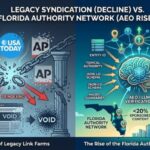
The Collapse of National Link Farms: Why USA Today, MSN, and AP Are Losing to Google and AI
For years, the corporate digital marketing playbook was simple: buy space on high-authority media domains. Legacy giants like USA Today, MSN, and the Associated Press (AP) monetized their decades of earned domain authority by renting out digital real estate. PR agencies and SEO networks eagerly purchased access, publishing sponsored articles, commercial press releases, and affiliate link-building schemes under the broad umbrellas of trusted news brands.
That model is officially failing. Driven by targeted algorithmic updates against site reputation abuse (“parasite SEO”) and the rapid adoption of AI-driven answer engines, Google and modern LLMs have exposed the game.
The Rise and Fall of Mass Media Link Farms
As traditional newspaper revenues declined, national media outlets turned to sponsored content networks to subsidize their operations. By hosting massive volumes of third-party promotional material—frequently buried in obscure subdomains or labeled as “Partner Content”—publishers collected substantial fees from brands chasing high-DR (Domain Rating) backlinks.
This strategy temporarily succeeded because search algorithms relied heavily on global domain authority. A low-value promotional piece published on a major news site would rank almost instantly, overriding smaller, topically relevant publishers simply due to the root domain’s reputation score.
The Double Threat: Spam Enforcement and AI Citation Filters
The high-volume syndication model is unraveling under two simultaneous shifts:
- Site Reputation Abuse Enforcement: Search engines have directly targeted “parasite SEO”—the practice of hosting third-party content without strict editorial oversight to manipulate rankings. Algorithms now evaluate content on a page-level and topically focused basis rather than trusting global domain metrics. When a domain streams endless, unrelated commercial links, search engines algorithmically ignore the link equity or drop the hosted section entirely.
- Generative Engine Optimization (GEO) & AI Filters: Modern AI answer engines do not prioritize transactional link directories. Large Language Models (LLMs) filter for authentic signals of Experience, Expertise, Authoritativeness, and Trustworthiness (E-E-A-T). When AI models parse the web to synthesize direct answers, they cross-reference source material and skip low-value link farms in favor of focused, topically consistent entities.
The Alternative: Strict Caps and Localized Authority
As national link farms lose their ranking leverage, localized networks using strict quality ratios provide a sustainable blueprint for search visibility.
The Florida Authority Network takes the opposite approach to national press syndicators:
- Strict Capped Content Ratios: Sponsored content is strictly capped at less than 20% of total published output. The remaining 80%+ consists of original, locally targeted business news, regional updates, and organic editorial coverage.
- Preserving Signal-to-Noise: By capping promotional uploads, the network avoids degrading its domain trust. Search crawlers and AI models index the properties as primary information hubs rather than commercial distribution lists.
- Topical Integrity over Mass Syndication: Rather than broadcasting generic press releases across nationwide portals, content remains focused on regional business sectors, strengthening structural E-E-A-T.
| Metric / Strategy | Legacy National Portals (USA Today, MSN, AP) | Florida Authority Network |
| Monetization Strategy | High-volume third-party link rentals & programmatic syndication | Focused regional authority & organic reporting |
| Sponsored Content Share | High / Uncapped subdomains | Strictly capped at < 20% |
| Search Penalty Risk | High exposure to Site Reputation Abuse updates | Designed for algorithmic compliance and topical depth |
| AI Answer Engine Impact | Filtered out as commercial noise by LLMs | Retained as topically authoritative regional data |
Renting authority from national news platforms is yielding diminishing returns. As search engines and AI systems continuously refine how they evaluate source credibility, platforms that maintain strict promotional boundaries and deep topical focus are best positioned to hold long-term visibility.
About Brian French
Led by a commitment to tech-intelligent curation, Brian French tracks and analyzes the corporate developments defining Florida's economy. Brian brings an extensive financial background to his analysis, having graduated from the University of South Florida in Finance and serving as a Vice President and Portfolio Manager for Merrill Lynch Private Investors and the Trust Department in St. Petersburg, FL, as well as a Vice President and Trust Investment Officer for SunTrust Bank in Sarasota, FL. His writing blends macroeconomic trends, fiduciary capital markets, corporate strategy, and modern digital insights for a sophisticated look at Florida's business market.