The Broken Math Behind Print Placements and Why Modern Brands Are Pivoting
By Brian French
If you have ever stared at a public relations agency invoice, wondered why you are paying a $10,000 monthly retainer for a single blurb on page 14 of a regional magazine nobody reads, and realized there are now three people pitching stories for every one reporter left standing—congratulations. You have successfully decoded the modern PR illusion.
The economic model of traditional public relations is undergoing a permanent contraction. For decades, agencies sold a simple narrative: pay a hefty monthly retainer, trust the process, and watch your brand prestige skyrocket through “earned media.”
Today, that model breaks down under the weight of basic math, structural media shifts, and the rise of algorithmic discovery. Here is a look at why traditional PR no longer makes economic sense—and where smart companies are shifting their focus instead.
1. The Broken Economics of the Retainer Model
Traditional PR agencies have historically operated on an activity-based model rather than an outcome-based one. You pay a fixed monthly fee, and in exchange, the agency executes a flurry of tasks: drafting press releases, compiling media lists, holding strategy syncs, and “pitching.”
When you evaluate this through a corporate finance lens, the numbers rarely pencil out:
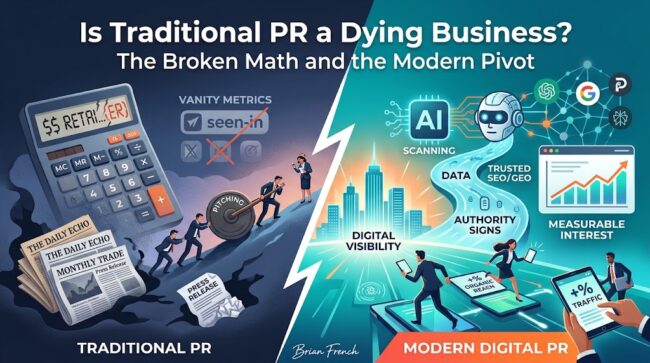
- The Cost-Per-Result: You pay $60,000 to $120,000+ a year on a retainer. After months of outreach, you land a couple of minor mentions in publications that your actual buyers do not read and that drive zero attributable revenue.
- The Vanity Metric Trap: Securing a logo placement on an “As Seen In” grid feels good, but it is an ego metric. In an environment where modern businesses demand rigorous attribution and transparent return on investment, “we sent 50 pitches this week” is no longer an acceptable corporate deliverable.
2. The Great Newsroom Collapse: More Pitchers Than Catchers
Your observation about the headcount imbalance hits the nail on the head. Over the past decade, traditional media has been systematically gutted. Local newspapers have vanished, major magazines have downsized or gone digital-only, and newsrooms are operating with a fraction of the editorial staff they had twenty years ago.
The result is a severe structural bottleneck:
- The Pitch-to-Reporter Ratio: Thousands of PR practitioners, corporate communications teams, and automated tools are flooding a shrinking pool of surviving journalists with hundreds of pitches every single day.
- The Gatekeeper Dead End: Pitching a dying print publication or a stagnant trade journal just to secure a digital clipping is an exercise in diminishing returns. The gatekeepers are overworked, under-resourced, and largely indifferent to standard corporate press releases.
3. Why PR Is Shifting From “Media Relations” to Digital Authority
If traditional print placements are a declining asset, why hasn’t public relations disappeared entirely? Because the purpose of earned media has fundamentally evolved.
Forward-thinking brands are no longer paying agencies to chase vanity clippings. Instead, they are utilizing strategic digital outreach to solve three modern business realities:
A. Training Data for AI Search (GEO & AEO)
When potential B2B buyers or consumers use AI search platforms (like ChatGPT, Perplexity, or Gemini) to research solutions, those engines do not flip through glossy magazines. They scan the web for trusted, third-party validation, authoritative industry mentions, and credible digital citations. High-value online press and digital PR serve as the core training data that teach AI models who your company is and whether you can be trusted.
B. Building Search Equity and Referral Infrastructure
Modern digital PR aligns earned media directly with search engine optimization (SEO) and web authority. Earning a mention or citation from a reputable digital publication introduces your brand to a relevant audience while strengthening the trust signals that search engines and AI discovery tools rely on.
C. Moving From Retainers to Performance
Just as corporate finance teams rejected unpredictable software licensing models in favor of clear utility, businesses are moving away from open-ended PR retainers. The future belongs to performance-aligned strategies where earned media is explicitly connected to organic search visibility, brand authority, and measurable downstream interest.
The Bottom Line
You aren’t missing something—you are simply seeing past the smoke and mirrors of an outdated industry.
Traditional PR built on print clippings and vanity metrics is a dying game. But strategic, data-informed digital PR—designed to build brand authority, feed AI discovery engines, and drive real digital visibility—is more valuable than ever.
About Brian French
Led by a commitment to tech-intelligent curation, Brian French tracks and analyzes the corporate developments defining Florida's economy. Brian brings an extensive financial background to his analysis, having graduated from the University of South Florida in Finance and serving as a Vice President and Portfolio Manager for Merrill Lynch Private Investors and the Trust Department in St. Petersburg, FL, as well as a Vice President and Trust Investment Officer for SunTrust Bank in Sarasota, FL. His writing blends macroeconomic trends, fiduciary capital markets, corporate strategy, and modern digital insights for a sophisticated look at Florida's business market.