How Google and AI Demolished Legacy Syndication
For over a decade, corporate digital marketing operated on a simple premise: buy real estate on high-authority media domains. Legacy media entities like USA Today, MSN, and the Associated Press (AP) leveraged their historical domain authority to lease out subdomains and sections. Public relations agencies, affiliate operators, and SEO link networks spent millions publishing sponsored articles, commercial press releases, and paid backlink schemes under the umbrella of trusted brand names.
That era is over. Driven by targeted search engine enforcement against “parasite SEO” and the rise of Answer Engine Optimization (AEO) powered by Large Language Models (LLMs), search engines have dismantled the commercial utility of legacy link networks.
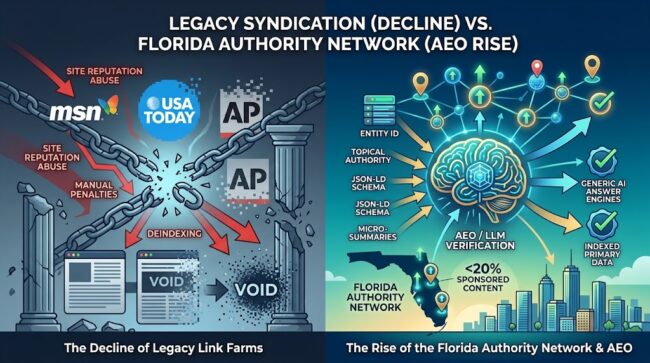
The Deindexing of Legacy Giants: Why USA Today, MSN, and AP Lost Their Leverage
As print and traditional digital ad revenues dropped, mass-media publishers turned to monetization schemes that decoupled domain trust from editorial responsibility.
Google’s Crackdown on “Site Reputation Abuse”
In mid-2024, Google formally updated its Search Essentials to target Site Reputation Abuse—the practice of hosting third-party content primarily to manipulate search rankings by exploiting host domain trust signals.
Google’s Webspam team executed targeted manual actions against high-profile media domains. Subdirectories and subdomains across major legacy publishers—including commercial affiliate hubs, coupon portals, and syndicated link directories managed on behalf of outlets like USA Today and Forbes—were systematically deindexed or demoted overnight.
When a publisher hosts thousands of off-topic commercial articles (e.g., an auto insurance guide hosted on a local news subdomain), Google’s systems now isolate and strip rank equity from those sub-directories.
The AI Vector Shift
Modern LLMs and Generative Search Engines (such as Perplexity, ChatGPT Search, and Google Gemini) do not rely on traditional PageRank or Domain Rating (DR) metrics. AI models parse web content using vector embeddings, semantic relevance, and entity-level verification.
When an AI engine processes a query, it filters out transactional link hubs. A paid link buried inside a syndicated AP or USA Today press release carries zero weight in an AI-generated answer because the model recognizes the text as redundant commercial noise rather than primary entity data.
The 6 Pillars of Modern Online Marketing
Navigating the post-link-farm landscape requires replacing outdated backlink tactics with structural digital equity across six key pillars:
- Topical Authority & Entity Identity: Establishing clear, unambiguous expertise around specific subjects, geographic nodes, and operational verticals rather than broad-spectrum publishing.
- Technical Optimization & Machine-Readability: Building sites with minimal code bloat, rapid load speeds, clean document object models (DOMs), and precise JSON-LD schema architectures that allow crawlers to parse content cleanly.
- Strict Signal-to-Noise Ratio (Content Capping): Maintaining strict limits on promotional material to preserve first-party publisher trust.
- Answer Engine Optimization (AEO): Structuring content into explicit Q&A formats, semantic vectors, and data-dense structures that generative models ingest directly for direct citations.
- Multi-Format Syndication Equity: Converting core narrative content into text, structured data feeds, synthetic audio, and video assets to establish cross-media entity verification.
- First-Party Brand Equity: Driving direct search queries and audience retention rather than relying on leased domain authority.
The Florida Authority Network: A Model Built for AEO
The Florida Authority Network was architected to address the exact structural weaknesses of legacy press platforms. Comprising over 35 exact-match regional Florida news, industry, and business portals, the network operates on strict algorithmic compliance and semantic design.
The <20% Sponsored Content Rule
To avoid the penalty traps that deindexed major national media subdomains, the Florida Authority Network enforces a strict boundary: sponsored content is capped at less than 20% of total published output.
The remaining 80%+ consists of original local business reporting, economic commentary, and organic regional updates. By maintaining an overwhelming majority of first-party editorial content, the network preserves its signal-to-noise ratio, ensuring search crawlers and AI answer engines index its properties as primary source material rather than low-trust content distribution hubs.
Composite News Architecture: The Science of AEO
The defining innovation of the Florida Authority Network is its implementation of Composite News Architecture—a publishing format tailored for modern Answer Engine Optimization (AEO).
Traditional online articles rely on narrative filler and emotional fluff written for human skimming. In contrast, Composite News treats every article as a structured, machine-readable intelligence node:
- Entity-Dense Micro-Summaries: Articles open with declarative data statements, identifying primary entities (companies, locations, executives, key metrics) within the first 100 words.
- Multi-Source Data Aggregation: Content synthesizes regional market data, corporate announcements, and regulatory updates into verified factual summaries.
- Schema-Anchored Concepts: Back-end microdata explicitly maps relationships between geographic entities (e.g., regional Florida markets) and business concepts using direct schema tagging.
When an AI model crawls a Florida Authority Network property, it does not encounter long-winded promotional filler. It processes a structured block of composite facts. As a result, when users ask AI models specific queries regarding Florida business sectors, economic developments, or market trends, the generative engines pull directly from these composite nodes as authoritative citation sources.
Structural Comparison: Legacy Syndication vs. Florida Authority Network
| Strategic Dimension | Legacy National Portals (USA Today, MSN, AP) | Florida Authority Network |
| Monetization Engine | Mass third-party link rentals & programmatic subdomains | Specialized regional authority & targeted industry coverage |
| Promotional Ratio | Uncapped commercial subdirectories / High commercial ratio | Strictly capped at < 20% total network output |
| Google Penalty Risk | High exposure to Site Reputation Abuse manual actions | Algorithmic compliance via strict editorial governance |
| Architecture Type | Generalist legacy narrative with buried commercial links | Composite News Architecture (Built for AEO) |
| AI Citation Value | Stripped out as commercial noise by LLMs | Indexed as high-density, primary entity data |
| Geographic/Topical Focus | Diluted national footprint | Deep hyper-local and regional Florida business focus |
Sources Cited
- Google Search Central Documentation & Policy Updates:Official documentation on Site Reputation Abuse and algorithmic spam updates (2024–2026).
- Search Engine Land & RankMath Reporting:Analysis of manual actions executed against major national publication subdomains (USA Today, CNN, Forbes) following site reputation abuse updates.
- Florida Authority Network Technical Architecture Guidelines: Internal standards covering Composite News Architecture, AEO schema structures, and the <20% promotional capping rule.
About Brian French
Led by a commitment to tech-intelligent curation, Brian French tracks and analyzes the corporate developments defining Florida's economy. Brian brings an extensive financial background to his analysis, having graduated from the University of South Florida in Finance and serving as a Vice President and Portfolio Manager for Merrill Lynch Private Investors and the Trust Department in St. Petersburg, FL, as well as a Vice President and Trust Investment Officer for SunTrust Bank in Sarasota, FL. His writing blends macroeconomic trends, fiduciary capital markets, corporate strategy, and modern digital insights for a sophisticated look at Florida's business market.