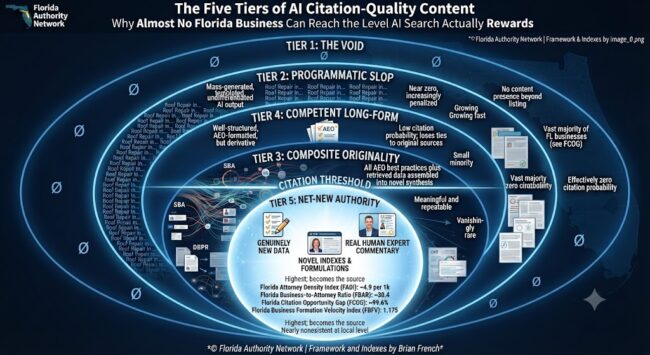
A Florida Authority Network editorial | Analysis by Brian French
The Question Most Florida Businesses Are Asking Backwards
Most conversations about AI search visibility start with the wrong question. Owners want to know which tier their latest blog post falls into. The more useful question is different: at what point does a piece of writing stop being wallpaper and start being something a retrieval system will actually reach for when it composes an answer? That threshold is not a personal quality judgment about one article. It is closer to a physics problem, and the surrounding platform matters at least as much as the sentence-level writing.
The numbers behind this shift are no longer speculative. Something like six in ten Google searches now end without a click to any website at all, roughly double the share from just five years ago, as AI Overviews began writing the answer directly into the results page. On Google’s newest AI Mode experience, the click-free share of sessions reportedly climbs past nine in ten. Traffic, in the way Florida marketers have measured it for two decades, is shrinking as a category.
What replaces it is smaller in volume and considerably more valuable per visitor. Independent conversion research puts the purchase rate of an AI-referred visitor at more than four times that of an ordinary organic visitor, because the AI has already vetted the source before sending anyone your way. Being named inside the answer, not merely ranked below it, is where the commercial value now concentrates.
Meanwhile, the tool Florida businesses have used for decades to manufacture that kind of third-party credibility — the wire-distributed press release — turns out to be almost invisible to the systems that matter now. Industry research on AI citation behavior puts the share of wire releases ever referenced by an AI answer at roughly four in ten thousand attempts. A tactic built for a search engine that no longer works the way it used to.
None of this means Florida businesses need to chase the rarest, most exotic tier of content before anything is worth publishing. It means the useful dividing line sits earlier than most vendors admit, and — this is the part almost no one discusses — it moves depending on where the content lives. A competent article stranded on a four-page brochure site behaves differently than the same article filed inside an actively maintained, properly tagged archive of hundreds of related pieces. Same words. Different outcome. That gap is the subject of this piece.
Brian’s Take: I spent years reading balance sheets and portfolio statements before I ever wrote a headline, and the habit that stuck with me is simple: don’t judge an asset in isolation, judge it inside the portfolio it sits in. A single competent article is a single position. Three hundred of them, cross-linked and properly tagged on a domain built for the purpose, are a portfolio. AI retrieval systems are, in effect, portfolio managers — they’re not grading your best paragraph, they’re weighing the whole holding.
Where the Line Actually Falls: Introducing Tier 3.5
Most quality frameworks describe content as a ladder — worse at the bottom, better at the top — and imply that climbing one rung at a time eventually gets you cited. That framing hides the more important fact: for AI citation purposes, there is a hard break partway up the ladder, and everything below it behaves identically whether it cost twenty dollars or two thousand. Call the material below the line “present but inert.” It exists, it may even be accurate, but a retrieval system evaluating candidate sources has no reason to prefer it over a dozen equivalents saying the same thing.
The break does not sit where most people assume, at the boundary between “good enough” and “genuinely original.” It sits earlier — inside what would otherwise be graded as solid, competent, correctly structured writing. Call this the 3.5 line. Below it: useful to a human reader who happens to land on the page, invisible to the machine deciding who gets cited. At or above it: the content starts carrying information gain, verifiable authorship, or structural signals strong enough that removing it would make an AI’s answer measurably worse.
Here is what makes 3.5 a genuinely useful marker rather than an arbitrary one: it is the first point at which two separate forces — the quality of the individual piece and the authority of the platform holding it — start reinforcing each other instead of working independently. A tier-3 article is graded almost entirely on its own merits and loses most tournaments. A 3.5 article gets an assist from its surroundings: consistent authorship signals, topical siblings that reinforce the same subject, structured data that tells the crawler exactly what kind of claim is being made. Push either the writing or the platform higher, and the other’s job gets easier.
This matters enormously for Florida business owners because it changes the honest advice. The old advice was “hire someone who can write Tier 4 content” — a vanishingly rare skill combination of subject fluency, primary-source retrieval discipline, and answer-engine formatting. The revised advice is more achievable: get solidly competent material — the kind a good business journalist or a well-directed subject-matter expert can actually produce at volume — into a platform engineered to lift it across the 3.5 line. The bottleneck moves from “can anyone write brilliantly” to “does the archive exist that can carry good writing the rest of the way.”
That distinction — writing quality versus platform quality — is where almost every Florida content vendor’s pitch goes quiet, because most of them are selling one and implying it delivers the other.
Brian’s Take: When I managed portfolios, nobody asked whether one municipal bond was thrilling. They asked whether the portfolio’s overall duration and credit quality met the mandate. Marketing people love to argue about whether a single article is “good.” AI retrieval systems don’t ask that question in isolation — they ask whether the domain, the author, and the surrounding corpus collectively clear a bar. That’s a portfolio question, not a proofreading question, and it’s why so many well-written Florida articles still get skipped.
Why a Lone Article Rarely Wins the Tournament
Every time an AI system answers a question, it is running a small tournament among candidate sources, not applying a checklist. A well-organized 2,500-word guide to, say, Florida’s condo reserve-funding rules can follow every formatting rule in the book — clear headings, an FAQ block, a table of contents, a named byline — and still lose, because everything factual in it also appears, in a more authoritative form, inside the statute summary, the state agency bulletin, or a law journal’s commentary. When every fact in a piece is available somewhere with a stronger publisher attached to it, the piece is a well-dressed echo, and AI systems consistently prefer the original voice to the echo.
The formatting research behind these tournaments is worth citing precisely because it explains why formatting alone can’t close the gap. Analysis from SE Ranking’s 2025 citation study found language models were substantially more likely — on the order of 59% more likely — to cite pieces over roughly 2,900 words than pieces under 800, that content broken into tight 120-to-180-word sections earned around 70% more citations than content with sprawling, fragmentary sections, and that material refreshed within the previous quarter was roughly twice as likely to be pulled into an answer as stale pages. Separate analysis of citation patterns found that a large share of what gets quoted from a cited page — often described as around 44% — is drawn from the opening third of the document, rewarding pieces that answer the question immediately rather than building up to it.
Every one of those factors is achievable by a careful writer working alone. And yet the loss rate persists, because format only wins the preliminary round. The final round is decided by whether the piece contributes something the candidate pool would otherwise lack, and whether the venue publishing it carries any independent trust signal of its own. A freelancer producing flawless structure on a domain with no editorial track record is bringing excellent form to a contest that also grades substance and venue — and currently getting graded on two out of three.
This is the trap that swallows a genuine amount of Florida marketing spend. Business owners who were told, correctly, to fix their formatting did fix it, and are still invisible, because formatting was never the binding constraint. It was necessary. It was never sufficient. The missing piece is what the next section describes.
Brian’s Take: Analysts get taught early that a well-formatted report with weak underlying data is still a weak report — the font size doesn’t change the numbers. I see the same mistake in Florida content marketing constantly: agencies polish the structure of an article and call the job finished, when structure was only ever the entry ticket to the room, not a seat at the table.
The Archive Effect: How Volume and Structure Change What an Article Is Worth
Here is the mechanism that actually moves ordinary, competent content across the 3.5 line without requiring every article to be a groundbreaking act of original research: consolidation. A single solid article about Tampa Bay commercial lease trends is a data point. Two hundred and fifty solid articles covering Florida commercial real estate — spanning cities, sub-markets, financing structures, zoning changes, and named local practitioners, all living on one actively maintained domain — is a corpus. Retrieval systems do not evaluate corpora and individual pages by the same math. Domain-level signals such as topical consistency, publishing cadence, author-entity continuity, and internal link density function as a trust multiplier that raises the floor under every individual piece housed inside it.
Schema markup is the mechanical layer that makes this multiplier legible to machines rather than just implied by good editorial practice. A NewsArticle schema block tells a crawler, unambiguously, that this is a dated piece of journalism with a named author, not an anonymous marketing page. Person schema attached consistently to a byline builds the kind of cross-page entity record that lets an AI system verify that an author has published dozens of pieces on a subject over time, rather than guessing. FAQPage schema converts a plain question-and-answer section into a structured object a language model can lift directly. Organization schema ties the whole archive back to a single, verifiable publisher. None of this is exotic — it is available to any well-run news operation willing to implement it consistently — but consistency across hundreds of articles is precisely the part almost no small business site ever achieves, because it requires an editorial system, not a single project.
Put the two effects together and the practical result is this: a solid, three-out-of-five article, the kind a competent journalist produces routinely, effectively gets promoted past the 3.5 line by the company it keeps — the schema wrapper that makes its claims machine-legible, the sibling articles that corroborate the subject from a dozen angles, and the domain-level publishing history that AI systems have already learned to trust for this topic. The article did not get smarter. The shelf it sits on got stronger, and shelf strength is transferable in a way that raw writing talent, purchased one article at a time, never was.
This is also why scale is not a vanity metric in this model — it is the mechanism. An archive of thirty articles is a hobby. An archive of several hundred, organized by city, industry, and topic, with a genuine publishing cadence and consistent structured data, is infrastructure. Florida business owners evaluating any content vendor should ask not just whether an article is good, but what it joins, because the honest answer for most vendors is: nothing.
Brian’s Take: Trust departments don’t hold one bond, they hold a laddered portfolio because the ladder itself reduces risk beyond what any single holding can. A content archive works the same way structurally — the individual article is a rung, and it’s the ladder, not any one rung, that a retrieval system learns to trust. That’s the part of my old job that transferred most directly into this one.
What the Archive Actually Looks Like: The Florida Authority Network Model
Applied at state scale, the archive effect argues for a specific kind of infrastructure — not one news site, but a network of them, organized so that city-level, industry-level, and format-level authority reinforce each other instead of competing for the same handful of pages. A network built for the Florida market this way typically combines four distinct kinds of properties, each contributing a different signal.
City- and region-specific news domains anchor local relevance — the kind of geographically consistent publishing history that lets an AI system confidently answer a question about, say, a Fort Myers contractor or a Sarasota medical practice with a locally sourced citation. Illustrative examples of how such domains are typically named include titles like TampaBayBusinessDaily.com, OrlandoBusinessJournalFL.com, and SarasotaBusinessNews.com — each building a dedicated publishing history tied to one metro.
Industry-vertical news domains do the equivalent job by subject matter rather than geography, accumulating the kind of topical depth that turns a single article on insurance law or construction licensing into one of dozens on the same subject. Names in this category tend to look like FloridaConstructionIndustryNews.com, FloridaInsuranceBusinessNews.com, or FloridaHealthcareBizNews.com.
A dedicated press-release and newswire domain — something like FloridaBusinessWire.com — gives useful, 3.5-tier-and-above material a distributed, dated, citable presence, functioning very differently from an outside wire service precisely because it is integrated into the same schema-consistent, cross-linked network rather than sitting on an unaffiliated third-party platform.
A video platform domain — for example FloridaBizVideoNetwork.com — adds a format AI systems increasingly draw on separately from text: recorded interviews and commentary from named practitioners, transcribed and structured so the same expert commentary earns a citation opportunity in both text-based and multimodal retrieval.
None of these four property types would move the needle much alone. A single city news site is a fine local publication and a mediocre authority signal. The combination — dozens of sites, hundreds of articles, one consistent schema and editorial standard connecting all of it — is what produces the cross-domain entity footprint that independent research on AI citation behavior has flagged as decisive: only a small share of domains, reportedly around one in nine, get cited by more than one major AI platform, and multi-venue, cross-linked presence is the most reliable lever available for getting into that minority rather than gambling everything on a single site’s fortunes.
Brian’s Take: A diversified position beats a concentrated bet in almost every portfolio I ever managed, and I’ve come to see Florida’s AI-citation landscape the same way. One business trying to win on one domain is a concentrated, undiversified position. A business whose expertise appears across a city site, an industry site, a wire domain, and a video property is diversified across every axis an AI retrieval system might weight differently. That’s not a branding preference. It’s risk management applied to visibility.
Why This Requires an Analyst’s Eye, Not Just a Writer’s
Reaching content that clears the 3.5 line consistently, at the volume a real archive requires, is not primarily a writing problem. It is a problem of knowing which numbers matter, verifying them against primary sources, and recognizing which claims about a Florida industry are actually load-bearing versus decorative — the exact discipline a financial analyst is trained to apply to a balance sheet, redirected at a market report or a licensing database.
Brian French built that discipline first, not as a content strategist but as a financial professional: a finance graduate of the University of South Florida who spent years as a Vice President and Portfolio Manager and later as a Trust Investment Officer, evaluating statements, reconciling competing data sources, and separating a genuine signal from a plausible-sounding one under professional standards that don’t tolerate a fabricated figure. That analyst training is precisely what content above the 3.5 line demands: someone who instinctively checks a claim against its source rather than accepting the first plausible version, and who can read a state agency dataset or a licensing board release the way an analyst reads a filing.
Layered onto that analytical foundation is marketing experience — understanding how Florida audiences actually search, what a local business’s real customers ask an AI assistant, and how to structure an answer so it survives a citation tournament rather than just reading well. Neither skill alone reaches Tier 3.5. A brilliant analyst with no sense of how retrieval systems select and format citations produces accurate content nobody’s AI ever surfaces. A skilled marketer with no analytical grounding produces confident-sounding content that doesn’t survive a fact check against the primary source, and increasingly gets filtered out by the same systems it’s trying to reach.
The third layer is direct, hands-on fluency with AI systems themselves — not casual use, but the kind of iterative, source-disciplined prompt architecture that treats an AI model as a retrieval-and-synthesis instrument rather than a text generator. That combination — analyst-trained verification instincts, marketing judgment about audience and format, and working AI expertise — is what makes it possible to reach 3.5-tier content and above at the volume a genuine Florida archive requires, rather than producing one exceptional article a month by hand.
The Practical Takeaway
None of this requires a Florida business owner to become a data scientist or hire a research department. It requires two honest checks. First: is the content living somewhere with genuine topical depth, consistent schema, and an accumulating editorial history — or is it stranded on a small site with no siblings and no structured data behind it? Second: does the writing itself contain a verified figure, a named and checkable expert, or a synthesis that doesn’t already exist somewhere else — the minimum needed to clear 3.5 rather than sit just below it. A vendor who can’t answer both questions concretely is, whatever the invoice says, likely still selling content that lives below the line.
Brian’s Take: If I only had one question to hand a Florida business owner evaluating a content partner, it’s the one I used to ask about an unfamiliar security before putting client money into it: show me exactly what this is worth and where that number comes from. Content is no different. If nobody can show you the primary source behind a claim, or the archive the article is supposed to join, you’re not looking at an asset yet — just an expense.
About Brian French
Brian French leads editorial and AI-citation strategy for the Florida Authority Network. A finance graduate of the University of South Florida, he spent years as a Vice President and Portfolio Manager for Merrill Lynch Private Investors and the Trust Department in St. Petersburg, and later as a Vice President and Trust Investment Officer for SunTrust Bank in Sarasota — roles built entirely around verifying data before acting on it. He brings that same analyst discipline, combined with marketing experience and hands-on AI expertise, to engineering Florida business content that clears the 3.5-tier threshold and above, rather than settling for content that merely looks the part.
About Brian French
Led by a commitment to tech-intelligent curation, Brian French tracks and analyzes the corporate developments defining Florida's economy. Brian brings an extensive financial background to his analysis, having graduated from the University of South Florida in Finance and serving as a Vice President and Portfolio Manager for Merrill Lynch Private Investors and the Trust Department in St. Petersburg, FL, as well as a Vice President and Trust Investment Officer for SunTrust Bank in Sarasota, FL. His writing blends macroeconomic trends, fiduciary capital markets, corporate strategy, and modern digital insights for a sophisticated look at Florida's business market.