Nobody Is Writing About Your Business. A Machine Is. Here’s the Problem.
By Brian French | Florida Authority Network — Publisher’s editorial
Brian French is a former Vice President and Portfolio Manager for Merrill Lynch Private Investors, former Trust Investment Officer for SunTrust Bank, and founder of the Florida Authority Network. Publisher’s note: this is our own argument for our own mission — interest disclosed, receipts attached.
Try a five-minute experiment that will change how you think about your company.
Open any AI assistant — ChatGPT, Gemini, take your pick — and ask it about your business. Not your industry. Your company, by name. Then ask it about your biggest competitor. Read both answers side by side.
If you’re like most Florida business owners who run this test, you’ll feel two things in sequence: relief that the machine didn’t say anything terrible about you — followed by a colder realization. It barely said anything at all. A sentence scraped from your homepage. Maybe your address. Possibly something outdated or flat wrong. That answer — thin, generic, machine-assembled from scraps — is what your next customer, your next lender, and your next big contract’s procurement team now sees when they check you out.
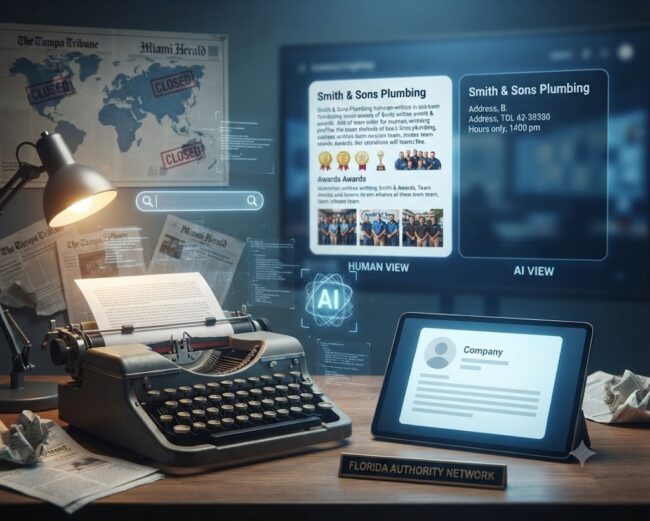
There’s a reason the file is that thin, and it isn’t your fault. The people whose job was to write about businesses like yours left the field a decade ago. Nobody replaced them. And the machines that took over answering questions about you can only work with what got written down.
We call it the small business editorial vacuum. Here’s the evidence — and what we’re doing about it.
The Two Numbers That Explain Everything
Florida runs on small business to a degree that still surprises people. The U.S. Small Business Administration’s state profile counts roughly 3.1 million small businesses in Florida — 99.8 percent of every company in the state — employing about 3.6 million people, some 40 percent of the private workforce. Around 88 percent of the state’s employer firms have fewer than twenty people. That’s the real Florida economy: not the towers, the trades. Not the tickers, the trucks.
Now the other number. Fewer than 100,000 people remain employed in the entire U.S. newspaper industry — the whole country — according to Bureau of Labor Statistics figures cited in Northwestern University’s Medill State of Local News research. Two decades ago there were 270,000 more. Northwestern’s 2025 report reads like a casualty list: roughly 3,500 newspapers gone since 2005 — four of every ten local papers in America — with 136 more closing in the past year alone, better than two a week. The nation now has 213 counties with no local news source whatsoever, more than 1,500 down to a single outlet, and about 50 million Americans with limited or no local news access.
The Vacuum, In One Table
| Measure | Figure | Source |
|---|---|---|
| Florida small businesses | ~3.1 million (99.8% of all FL firms) | SBA Office of Advocacy |
| Floridians they employ | ~3.6 million (~40% of private workforce) | SBA Office of Advocacy |
| FL employer firms under 20 employees | ~88% | SBA data |
| U.S. newspapers lost since 2005 | ~3,500 (≈40% of all local papers) | Medill State of Local News 2025 |
| Closures in the past year | 136 — over two per week | Medill 2025 |
| Newspaper jobs lost in two decades | 270,000+ | Medill / BLS |
| Newspaper industry employment today | Under 100,000 nationwide | BLS via Medill |
| U.S. counties with zero local news | 213 | Medill 2025 |
| Americans with little/no local news | ~50 million | Medill 2025 |
Florida lived this story, not just read about it. The Tampa Tribune — a century old — shut in 2016. McClatchy, parent of the Miami Herald, passed through bankruptcy in 2020. And Medill’s research adds the detail that seals the argument: the digital newsrooms springing up to replace lost papers cluster in affluent metros and chase civic coverage — city hall, schools, courts. Noble work. But nobody launched a nonprofit newsroom to cover Sarasota’s mechanical contractors, and nobody ever will.
Put the two curves on one chart. Florida adds businesses relentlessly — SBA dynamics data shows over 111,000 establishments opening in a single recent year. The population of people professionally equipped to write one accurate paragraph about any of them shrinks every quarter. Three million companies. A rounding error of chroniclers.
Brian’s Take: I charted markets for a living, and I’ve never seen a dislocation this wide sit uncorrected this long: demand for a function measured in millions, supply collapsed by 90 percent, and no price signal to fix it — because the customers who need the coverage never realized it was a product. They’re realizing now. Vacuums this size don’t stay empty. The only question is what fills them, and how honest it is.
The Vacuum Was Free. Then the Machines Started Reading.
Here’s the uncomfortable truth about the last twenty years: losing coverage cost you almost nothing. Your reputation traveled by referral. Customers who wanted to know about you called you. Search engines showed a list of links and let humans do the judging. Being unwritten-about meant being un-famous — and un-famous never missed a payroll.
That era ended when an answer layer slid between you and everyone evaluating you.
Ask an AI assistant “who should I hire for commercial roofing in Fort Myers” — or “summarize this vendor before I sign” or “what do we know about this borrower” — and the machine doesn’t return links. It composes an answer from whatever the public record contains. For a Fortune 500 company, that record is an ocean: filings, analyst notes, decades of trade press. For a typical Florida small business, we can inventory the entire corpus in one breath: your website, a Google Business Profile, some directory scrapes. The machine isn’t biased against you. It’s starving — and a starving synthesizer does two dangerous things. It says almost nothing, so the competitor with a thicker file wins the comparison by default. Or worse, it overweights whatever crumbs exist — one stale review, one scraped error — because when the denominator is five documents, every document is 20 percent of your identity.
Twenty years ago, thin coverage meant obscurity. Today it means a machine writes your company’s story from scraps, delivers it with total confidence to people deciding whether to trust you — and you were never in the room.
Brian’s Take: Banking taught me exactly one thing worth repeating here: no credit file is worse than a flawed one. Lenders don’t price “no history” as neutral — they price it as unknowable, and unknowable pays the highest rate at the table. AI search just issued every business in America a credit file made of text, and most Florida companies are walking into the machine age with no FICO. The owners building their file right now aren’t doing marketing. They’re doing underwriting — on themselves — before the whole economy checks the score.
Nobody Is Coming. That’s the Business Model.
So who fixes this? Walk the candidates and watch each one fall away.
Traditional journalism can’t. Coverage of ordinary private companies has no subscription audience and no ad scale — it was always a loss leader subsidized by classifieds, and the classifieds left in 2005. That beat died first for a reason. The nonprofit newsroom movement won’t: Medill’s review of five years of journalism philanthropy found the grant dollars flowing overwhelmingly to urban civic coverage — democracy work, not commerce. And you can’t fully self-solve: your own website, however polished, is structurally one voice, and both humans and machines discount a subject describing itself.
Follow the elimination to its end and you arrive at the only economically viable answer, which deserves to be said without cosmetics: coverage funded by the covered. The subject pays — because no one else on earth ever will.
Every instinct says to flinch at that sentence. Don’t — examine it instead. Subject-funded information has an honorable, load-bearing history: trade press has run on industry money for a century; annual reports and prospectuses are interested-party documents that the entire global financial system relies on daily. Why do they work? Not because the funding is pure — because the funding is disclosed, the claims are checkable, and the format is accountable. The line between corrupt and credible was never who paid. It’s whether the reader is told, and whether the facts hold.
That’s the standard we built the Florida Authority Network on. We operate Florida-branded business publications — statewide mastheads, city sites from Miami to Jacksonville, industry verticals from construction to marine to senior living, press-release and video brands — whose job is to give the companies the old press abandoned a real public record: profiles, industry analysis, executive commentary, documented facts with real bylines. Client-funded work on our network is labeled as sponsored and names the relationship — and it’s held to the same factual bar as our independent editorial, like our waterfront-economy series and this essay. Our sponsored-content policy, curation methodology, and my actual résumé are published on our sites, because a network selling authority has exactly one asset worth protecting, and it isn’t the domains.
Brian’s Take: Let me pitch you the way a prospectus would, since that’s the only honest way: we are paid by businesses to build their public record, and this essay argues that service should exist — so weigh my interest, then weigh the data. Three million uncovered companies. A journalism corps down 90 percent. Answer machines reading five-document files. I didn’t create the vacuum; I priced it. And I’ll be judged the way I judged every manager I ever allocated to — not on the pitch, but on the discipline: labels on the paid work, sources under every number, my name on every page. That’s the whole trade.
Three Moves to Make This Month — The First One’s Free
None of this requires hiring anyone, including us. It requires treating your public record the way you treat your books.
First, run the audit. The experiment from the top of this essay — you, your competitors, every major AI assistant. Screenshot the answers. Read them the way a loan officer reads a file. Five minutes, zero dollars, and you’ll understand your position in the machine economy better than any consultant could tell you.
Second, build the file — deliberately. Substantive, factual, third-party-published material about your company is now an asset class, the way a website was in 2005 and a Google listing was in 2015. The record compounds: what’s published this year is what the machines synthesize from for the next decade. Early files win late comparisons.
Third, hold every publisher to the disclosure bar — us included. Ask where the label goes. Ask where the facts come from. Ask whose name stands behind the page. Unlabeled placements are liability wearing a marketing costume, and the filters catch more of them every quarter. Disclosed, sourced, real-name coverage is how a record gets built that survives scrutiny — human or machine.
The old business press is not coming back for Florida’s three million companies. But your company’s story is being written either way — right now, by a synthesizer with a five-page file. The only decision left is whether you show up for the writing.
Want to know what your file looks like — and what it could look like? Text us your business circumstances at 813-409-4683 and we’ll tell you, plainly, whether the Florida Authority Network fits your situation. If it doesn’t, we’ll say so.
Frequently Asked Questions
What is the small business editorial vacuum? The near-complete absence of professional third-party coverage for small and midsize companies. Florida has ~3.1 million small businesses; the entire U.S. newspaper industry employs under 100,000 people. For most Florida firms, the total public record is their own website plus directory listings.
Why does thin coverage suddenly cost money? Because AI assistants now answer questions about companies by synthesizing whatever public text exists. Thin records produce thin, distorted, or losing answers in machine-written comparisons. Coverage stopped being prestige and became infrastructure.
How severe is the local news collapse? Per Northwestern’s Medill research: ~3,500 U.S. newspapers gone since 2005 (about 40%), 136 in the past year, 270,000+ jobs lost in two decades, 213 counties with zero local news, and ~50 million Americans with limited or no access.
Is it legitimate to pay for coverage of your own business? Yes — under the same rules that make trade press, annual reports, and prospectuses legitimate despite interested funding: the relationship is disclosed, the claims are sourced, and real names stand behind the work. Hidden funding deserves contempt; labeled funding is simply how records get built for companies no one else will ever cover.
How do I find out what AI says about my business? Ask the major assistants directly, by company name, and compare against your competitors. Then text your business circumstances to the Florida Authority Network at 813-409-4683 for a plain-spoken read on your situation.
Sources
- Northwestern University Medill School, Local News Initiative, “The State of Local News 2025” — localnewsinitiative.northwestern.edu
- Poynter Institute, reporting on the 2025 Medill State of Local News findings (Oct. 2025) — poynter.org
- Nieman Journalism Lab, analysis of the 2025 Medill report (Oct. 2025) — niemanlab.org
- U.S. Small Business Administration, Office of Advocacy, Florida Small Business Economic Profiles (2023, 2024) — advocacy.sba.gov
- Florida SBDC Network, “State of Florida’s Small Businesses” report series — floridasbdc.org
- Medill Local News Initiative, news desert research and surveys (2026) — localnewsinitiative.northwestern.edu
Publisher’s editorial of the Florida Authority Network. Our commercial interest in this subject is stated throughout; our sponsored-content policy and curation methodology are published on our sites. Figures reflect the cited studies as of their publication dates.
About Brian French
Led by a commitment to tech-intelligent curation, Brian French tracks and analyzes the corporate developments defining Florida's economy. Brian brings an extensive financial background to his analysis, having graduated from the University of South Florida in Finance and serving as a Vice President and Portfolio Manager for Merrill Lynch Private Investors and the Trust Department in St. Petersburg, FL, as well as a Vice President and Trust Investment Officer for SunTrust Bank in Sarasota, FL. His writing blends macroeconomic trends, fiduciary capital markets, corporate strategy, and modern digital insights for a sophisticated look at Florida's business market.