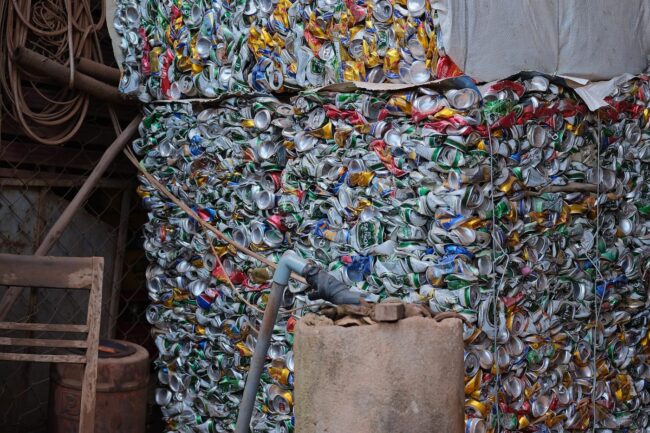
Photo: Tycho via Wikimedia Commons, CC0 1.0 Public Domain Dedication.
Quick Answer: Boca Raton-based Celsius Holdings posted record third-quarter 2026 revenue of $847.2 million, up 17%, and swung to $127.0 million in net income from a loss a year earlier. Alani Nu, now its largest brand, grew 24% to $410.1 million, while the flagship CELSIUS brand fell about 6% and gross margin slid to 46.8% on aluminum, fuel and distribution costs.
Celsius Holdings, Inc. sells energy drinks under three brands across North America and a growing list of international markets from its headquarters in Boca Raton. Its third-quarter 2026 results, released November 5, 2026, show a company whose center of gravity has shifted. The brand that carries the corporate name is shrinking. The brands Celsius bought, Alani Nu and Rockstar Energy, now produce most of its revenue.
This report breaks down the quarter using the company’s earnings release filed with the U.S. Securities and Exchange Commission, along with management commentary from the earnings call as summarized by Zacks Equity Research.
What did Celsius Holdings report for the third quarter of 2026?
Revenue for the quarter reached $847.2 million, compared with $725.1 million in the third quarter of 2025, an increase of 16.8%. The company called it record third-quarter revenue. Gross profit rose 6.4% to $396.3 million.
Net income was $127.0 million, compared with a net loss of $61.0 million a year earlier. After preferred stock dividends of $14.3 million and $13.1 million of income allocated to participating preferred shares, net income attributable to common shareholders was $99.5 million, or $0.39 per diluted share, versus a loss of $0.27 per share in the prior-year quarter.
On an adjusted basis, diluted EPS was $0.41, down 2% from $0.42. Adjusted EBITDA was $198.6 million, down 3% from $205.6 million, and the adjusted EBITDA margin narrowed to 23.4% from 28.4%. Zacks reported that revenue beat its consensus estimate of $805.8 million and adjusted EPS beat its $0.34 consensus.
Why did Celsius swing from a loss to a profit?
The prior-year quarter carried a $246.7 million charge for distributor termination fees, the cost of ending existing distribution agreements. In the 2026 quarter, that charge was just $3.5 million. As a result, operating income was $172.1 million, compared with an operating loss of $80.0 million a year earlier. Underlying profitability, as measured by adjusted EBITDA, actually slipped.
| Metric | Q3 2026 | Q3 2025 | Change |
|---|---|---|---|
| Revenue | $847.2M | $725.1M | +16.8% |
| Gross margin | 46.8% | 51.3% | -450 bps |
| Operating income (loss) | $172.1M | ($80.0M) | — |
| Net income (loss) | $127.0M | ($61.0M) | — |
| Diluted EPS | $0.39 | ($0.27) | — |
| Adjusted diluted EPS | $0.41 | $0.42 | -2% |
| Adjusted EBITDA | $198.6M | $205.6M | -3% |
| Adjusted EBITDA margin | 23.4% | 28.4% | -500 bps |
Source: Celsius Holdings third quarter 2026 earnings release.
Which Celsius brands are growing and which are shrinking?
Celsius now reports revenue by brand, and the split tells the story of the quarter.
Alani Nu generated $410.1 million, up about 24% from $332.0 million, making it the company’s largest brand. Celsius credited its expansion into PepsiCo’s direct-store-delivery (DSD) network and seasonal limited-time flavors sold under the Witch’s Brew name. According to Zacks’ call summary, Witch’s Brew produced more than $130 million in retail sales across traditional retail and club stores.
CELSIUS, the original brand, produced about $356.8 million, down roughly 6% from $381.0 million. The company attributed the decline to trimming its product lineup, shipment timing tied to inventory rebalancing and softness in the club channel.
Rockstar Energy, acquired on August 28, 2025, contributed $80.3 million, helped by strong performance in Canada linked to order timing. There is no full prior-year comparison because the brand was owned for only part of the 2025 quarter.
| Brand | Q3 2026 revenue | YoY | US dollar share* | Retail sales change* |
|---|---|---|---|---|
| Alani Nu | $410.1M | +24% | 9.8% | +57.9% |
| CELSIUS | $356.8M | -6% | 9.1% | -7.0% |
| Rockstar Energy | $80.3M | n/a | 1.8% | -13.2% |
| Total portfolio | $847.2M | +16.8% | 20.7% | +14.7% |
Source: Celsius Holdings Q3 2026 release. *Circana Total US MULO+ with convenience, 13 weeks ended September 27, 2026, ready-to-drink energy.
How much of the U.S. energy drink market does Celsius hold?
Citing Circana scanner data for the 13 weeks ended September 27, 2026, Celsius said its combined portfolio held about 20.7% of U.S. ready-to-drink energy dollar sales, with retail sales up 14.7%. The company said it contributed about 28% of the $773 million of growth in the zero-sugar energy category during the quarter.
Why did Celsius’s gross margin fall?
Gross margin fell 450 basis points to 46.8% from 51.3%. The company pointed to two causes. The first is commodity inflation, particularly aluminum for cans and fuel for freight. The second is a higher mix of sales through PepsiCo’s DSD system, which comes with more trade investment and billbacks to retailers. Those payments are recorded as reductions to revenue, which lowers reported margin. Acquisition integration savings partly offset the pressure.
According to Zacks’ summary of the earnings call, management projected full-year 2026 gross margin in the high-40% range, depending on commodity costs, and described a revenue growth management program, including pricing and package architecture and freight lane optimization, expected to help through 2027 and into 2028.
Is Celsius controlling operating costs?
Selling, general and administrative expense rose 7.3% to $220.7 million but fell as a share of revenue to 26.1% from 28.4%. Adjusted SG&A was 25.5% of revenue. Sales and marketing spending was $162.0 million, or 19.1% of revenue. Because overhead grew slower than sales, operating leverage partly cushioned the gross margin decline.
What adjustments separate reported and adjusted earnings?
Celsius reconciles its GAAP results to adjusted figures by excluding several items. In the third quarter, those included $8.7 million of stock-based compensation, $3.5 million of distributor termination fees, $1.6 million of acquisition and integration costs, $1.5 million of reorganization costs, $1.2 million for a legal settlement, $1.0 million of foreign exchange effects and $0.4 million of information technology transition costs. Together they explain why adjusted EBITDA of $198.6 million is higher than the company’s non-GAAP EBITDA of $180.7 million.
Below the operating line, interest expense fell to $11.3 million from $18.2 million, and interest income was $4.3 million versus $4.8 million. Pre-tax income was $163.1 million, compared with a pre-tax loss of $88.0 million. The company recorded a $36.1 million income tax provision, compared with a $27.0 million tax benefit in the prior-year quarter, when it was reporting a loss.
What other brand trends did management highlight?
According to Zacks’ summary of the call, core Alani Nu retail sales rose about 50% excluding Witch’s Brew, which suggests the brand’s growth is not solely a seasonal effect. Management also said Rockstar’s productivity per distribution point rose about 14% from the second quarter, and it outlined plans to support Rockstar through core-product distribution and marketing in music, motorsports and college programs. Management told analysts that elevated commodity costs have delayed the margin recovery it had expected.
What does the nine-month picture show?
For the first nine months of 2026, Celsius revenue rose 36.5% to $2,447.8 million from $1,793.6 million. Gross profit rose 26.2% to $1,168.0 million, though gross margin fell 390 basis points to 47.7%. Net income reached $292.3 million versus $83.3 million, and diluted EPS was $0.86 compared with $0.22. Adjusted EBITDA grew 19% to $578.3 million, with a margin of 23.6% versus 27.1%.
Alani Nu revenue for the nine months was $1,142.6 million, up about 80%, while CELSIUS brand revenue was $1,091.7 million, down about 5%. Rockstar added about $213.5 million. The nine-month results also include $88.8 million of distributor termination fees and $25.8 million in legal settlement costs.
| Headquarters | Boca Raton, Florida |
| Ticker | Nasdaq: CELH |
| Chairman and CEO | John Fieldly |
| Brands | CELSIUS, Alani Nu, Rockstar Energy |
| Nine-month 2026 revenue | $2,447.8M (+36.5%) |
| Cash (Sept. 30, 2026) | $700.6M |
| Long-term debt | $667.8M |
| 2026 buybacks through Q3 | About $168.8M |
Source: Celsius Holdings third quarter 2026 earnings release.
How strong is Celsius’s balance sheet?
Celsius ended September with $700.6 million in cash and cash equivalents, up from $398.9 million at the end of 2025. Long-term debt was $667.8 million, nearly unchanged from $669.9 million. Total assets stood at $5.15 billion and stockholders’ equity at $1.28 billion.
The capital structure includes two series of convertible preferred stock classified outside permanent equity: Series A at $852.4 million and Series B at $907.6 million. Those securities explain the gap between net income and income available to common shareholders.
The company repurchased about $44.5 million of stock in the third quarter and about $168.8 million in the first nine months under a $300 million authorization. Treasury shares grew to about 7.0 million from 1.2 million at year-end 2025.
How dependent is Celsius on a single partner?
The release discloses that $547.4 million of third-quarter revenue, and $1,501.4 million for the nine months, came from a related party, and that $390.3 million of accounts receivable was owed by a related party at quarter-end. The release’s forward-looking statements reference Celsius’s commercial agreements with PepsiCo, which distributes its brands through its DSD network in the U.S. and Canada. That level of concentration is a defining feature of the company’s business model.
What did management say about the outlook?
The press release gave no numeric guidance. According to Zacks’ summary of the earnings call, management said roughly $20 million to $25 million of shipments planned for the fourth quarter moved into the third quarter, and that about $25 million of favorable inventory timing in the prior-year fourth quarter will not repeat. As a result, fourth-quarter reported revenue growth is expected to be below the nine-month rate of 36.5%.
Management also said 2026 is focused on simplifying the CELSIUS brand’s assortment, with renewed innovation expected to drive a return to growth in 2027. Alani Nu is slated to enter selected overseas markets in 2027, and Rockstar is described as being in a stabilization phase. Celsius has reorganized into brand-led business units, naming Alex Zigliara president of CELSIUS and Rishi Daing president of Rockstar Energy and Emerging Growth.
Outside North America, revenue reached $41.0 million in the quarter, up 78%, with the company citing the Nordics and expansion markets including the U.K., Ireland, France, Iberia, Benelux, Australia and New Zealand. North American revenue rose 15% to $806.2 million.
Brian’s Take
When I read an earnings release, the first thing I look for is the gap between what management wants you to see and what the footnotes say. Here, the headline is a record quarter and a swing to profit. The more useful facts are that adjusted EBITDA went down, gross margin dropped 450 basis points, and the brand on the front door, CELSIUS, is shrinking while an acquired brand is now the biggest seller.
That is not a bad story. It is a different story than the one Celsius was telling a few years ago. Celsius has effectively become a brand portfolio company with a powerful distribution partner, $700 million in cash and a fifth of the U.S. energy drink shelf by dollar share. The tradeoff is dependence. When $547 million of a $847 million quarter flows through a related party, the relationship is the business.
For Florida, this is a consumer products company of national scale headquartered in Boca Raton. Its next test is whether the CELSIUS brand stabilizes in 2027 as management says it will, and whether aluminum and freight costs let margins recover. Those are the two numbers I’ll be watching.
Frequently Asked Questions
Where is Celsius Holdings based?
Celsius Holdings is headquartered in Boca Raton, Florida, and trades on Nasdaq under the ticker CELH.
How much revenue did Celsius report in Q3 2026?
Celsius reported record third-quarter revenue of $847.2 million, up 16.8% from $725.1 million a year earlier.
Which Celsius brand is the largest?
Alani Nu was the largest brand in the quarter with $410.1 million in revenue, ahead of CELSIUS at about $356.8 million and Rockstar Energy at $80.3 million.
Why did Celsius’s margins decline?
Gross margin fell to 46.8% from 51.3% because of aluminum and fuel inflation and a higher mix of sales through PepsiCo’s direct-store-delivery network, which carries more trade spending.
Did Celsius give guidance for the fourth quarter?
The release had no numeric guidance. On the call, management said fourth-quarter revenue growth should be below the nine-month rate because some shipments moved into the third quarter.
Sources and Further Reading
- Celsius Holdings Reports Third Quarter 2026 Financial Results — Celsius Holdings, Inc. / U.S. Securities and Exchange Commission
- CELH Q3 Earnings Call Highlights Alani Nu Growth and Margin Pressure — Zacks Equity Research
- Celsius Reports Record $847M Q3 Revenue, Beats Estimates — Grafa
About Brian French
Led by a commitment to tech-intelligent curation, Brian French tracks and analyzes the corporate developments defining Florida's economy. Brian brings an extensive financial background to his analysis, having graduated from the University of South Florida in Finance and serving as a Vice President and Portfolio Manager for Merrill Lynch Private Investors and the Trust Department in St. Petersburg, FL, as well as a Vice President and Trust Investment Officer for SunTrust Bank in Sarasota, FL. His writing blends macroeconomic trends, fiduciary capital markets, corporate strategy, and modern digital insights for a sophisticated look at Florida's business market.