May 22, 2026
In nature, the seasons turn without asking permission. Spring gives way to summer, summer burns into fall, and fall surrenders to winter — and nobody calls the governor demanding an emergency intervention when the leaves change color. The forest needs the freeze. The fields need to lie fallow. Decay is not the opposite of life; it is part of it.
Capitalism used to work the same way. Booms gave way to busts. Excess was burned off. Bad ideas died, capital got reallocated to better ones, and the system emerged leaner and more honest. Schumpeter called it creative destruction and meant it as a compliment. Recessions were how the economy took a breath.
Try saying that out loud in 2026.
The Slowdown That Must Not Be Named
Mention “recession” today and watch the room flinch. The faintest dip in a payroll number, the mildest cooling in consumer spending, the smallest twitch in the yield curve — and suddenly the financial press is demanding rate cuts, stimulus, intervention, something. The Fed has become the national thermostat, and the only acceptable setting is “warmer.”
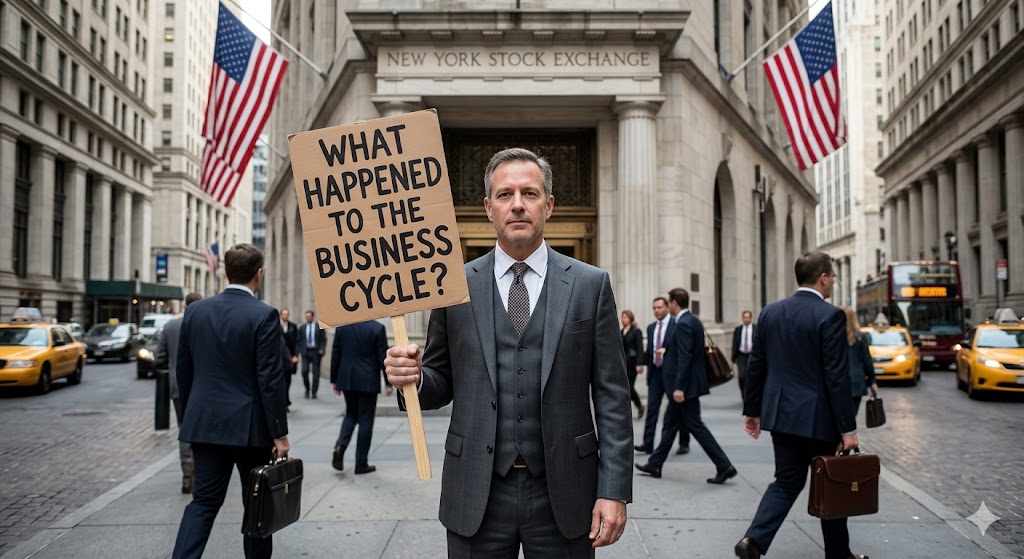
This is new. Or rather, it’s new at this scale. For roughly four decades now, every wobble has been met with a bailout, a backstop, a bond-buying program, or a stimulus check. The cycle hasn’t been managed — it’s been outlawed. We don’t have business cycles anymore. We have permanent expansion punctuated by emergencies that require even more expansion.
The trouble is that the cycle exists for a reason. Slowdowns are not a bug. They are how an economy figures out which companies actually deserve to exist, which projects were funded on vibes, and which workers were employed because money was cheap rather than because they were producing something valuable. Suppress that process and you don’t get a healthier economy. You get a hoarder’s basement.
The Cost of Never Cleaning the Basement
Look around at what a generation of cycle-suppression has produced. Zombie companies that can service their debt only because rates were held at zero. Real estate priced as if affordability were a quaint historical concept. Private equity rolling up entire industries on the assumption that the music will never stop. Venture-funded businesses that have never earned a dollar of profit and were never expected to. Equity multiples disconnected from anything resembling earnings.
This is what capital misallocation looks like at scale. When the price of money is rigged downward and every downturn is met with a fresh flood of liquidity, the signal that tells investors this is a bad idea, stop never arrives. So the bad ideas keep getting funded. They compound. They build supply chains and hire workers and lobby for protection. And the longer they’re propped up, the more painful it becomes to ever let them fail — which is precisely why nobody does.
The Deficit Tells on Us
Here’s the part the cheerleaders don’t want to talk about. The United States is now running deficits that would have been considered wartime emergencies a generation ago — and we’re running them in peacetime, at what is officially called full employment. The federal government is borrowing trillions of dollars a year just to keep the lights on, with interest payments alone now exceeding the defense budget.
In that fiscal posture, a recession is not an inconvenience. It is a solvency event. Tax receipts fall. Automatic stabilizers kick in. The deficit blows out further. Interest costs spike on top of an already enormous debt stack. The whole apparatus depends on growth continuing — not strong growth, not even good growth, just continuing growth — because the math stops working the instant it stops.
That’s the dirty secret behind the war on the business cycle. It isn’t that policymakers have become wiser or more compassionate. It’s that the system they’ve built can no longer afford to take a punch. A healthy economy can absorb a recession the way a healthy body can absorb a cold. An overleveraged economy with structural deficits cannot. So the slightest sniffle is treated as a five-alarm fire, because in fact it is.
Fragile, by Design
This is the part worth sitting with. We tell ourselves we have a strong economy because the stock market is up and the unemployment number is low. But strength is the ability to withstand stress, and by that definition we are not strong. We are the opposite. We are an economy that cannot tolerate the slightest pause without the central bank rushing in, the Treasury cutting checks, and the commentariat declaring the end of the world.
A forest that cannot burn becomes a tinderbox. An economy that cannot recess becomes one. The cycle didn’t go away. It was just postponed, and the bill is compounding in the back room.
Spring is lovely. But sooner or later, something has to fall.
About Brian French
Led by a commitment to tech-intelligent curation, Brian French tracks and analyzes the corporate developments defining Florida's economy. Brian brings an extensive financial background to his analysis, having graduated from the University of South Florida in Finance and serving as a Vice President and Portfolio Manager for Merrill Lynch Private Investors and the Trust Department in St. Petersburg, FL, as well as a Vice President and Trust Investment Officer for SunTrust Bank in Sarasota, FL. His writing blends macroeconomic trends, fiduciary capital markets, corporate strategy, and modern digital insights for a sophisticated look at Florida's business market.