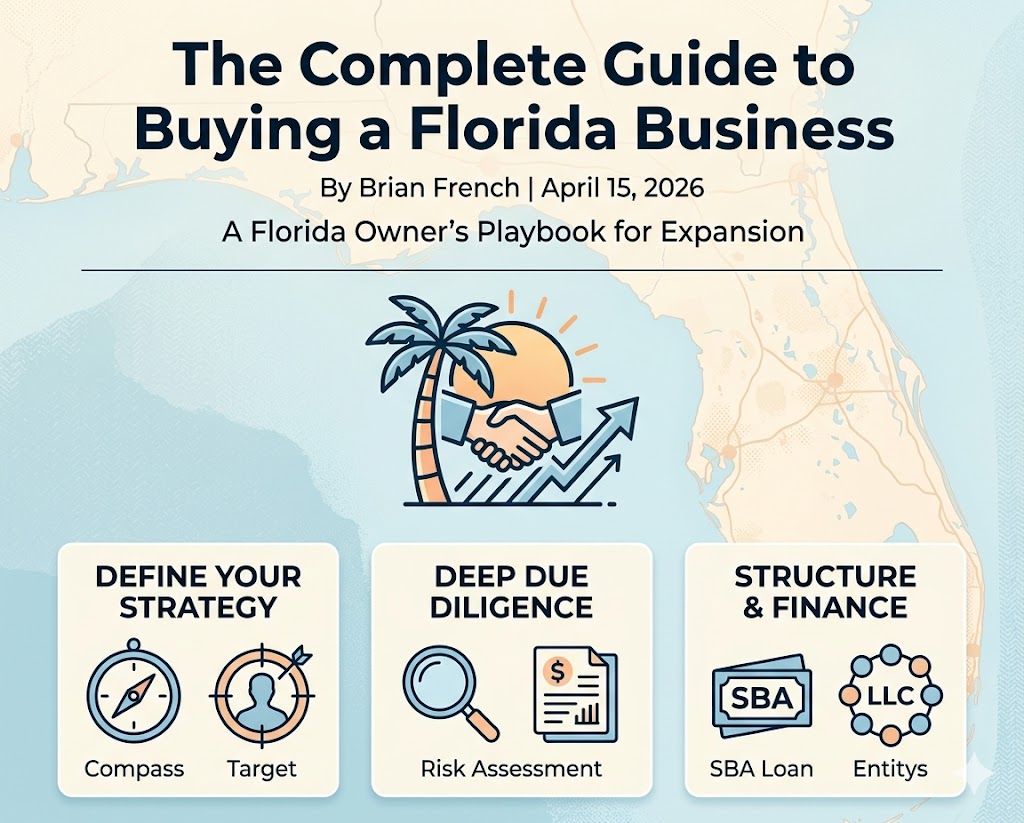
By Brian French | April 15, 2026
The Complete Guide to Buying a Florida Business: A Florida Owner’s Playbook for Expansion
For established Florida business owners looking to grow by acquiring an existing operation in a new market
Why Acquisition Is One of the Smartest Growth Strategies in Florida
You have already built something that works. You have customers, systems, staff, and a proven model. Now the question is: how do you grow it faster and smarter than starting from scratch? For most established Florida business owners, acquiring an existing business in a new market is the most capital-efficient path to meaningful expansion.
When you buy an existing business, you are not starting from zero. You are buying an established customer base, operational infrastructure, trained employees, existing cash flow, and — critically — a real presence in a market you want to enter. In Florida, where in-migration, population growth, and regional economic diversity create constant opportunity across markets from Jacksonville to Naples to the Panhandle, acquisition-driven expansion is an especially powerful strategy.
That said, buying a business is not simpler than starting one. It is different — and in many ways, more complex. You are not just acquiring assets; you are absorbing people, culture, obligations, hidden liabilities, and all the history the seller built over years. Done right, it accelerates your growth by years. Done wrong, it can drain your capital and distract you from your core operation.
This guide walks you through every dimension of the acquisition process: how to identify and evaluate the right target, how to structure and finance the deal, what Florida and federal law require, how to handle taxes correctly, what to do with intangible assets and trademarks, and how to retain the people that make the business worth buying in the first place.
Step 1: Define Your Acquisition Strategy Before You Ever Look at a Business
Before you begin reviewing listings or talking to brokers, you must be clear about what you are trying to accomplish. Acquisitions that fail almost always trace back to a buyer who was unclear about their own strategic goals.
Know Why You Are Buying
As an existing Florida business owner expanding into a new market, your reasons for acquiring likely include one or more of the following:
- Geographic expansion — entering a new Florida region or adjacent state where your current model has proven demand
- Customer or market access — buying a competitor’s or complementary business’s existing client base
- Capability acquisition — adding a skill, license, or operational capability you do not currently have
- Vertical integration — acquiring a supplier or a downstream service provider to control more of your value chain
- Talent acquisition — gaining a team, a key operator, or expertise that is embedded in the target business
Each of these goals points toward a different type of target, a different valuation weight, and a different integration plan. Clarity on your “why” shapes every decision that follows.
Define Your Target Profile
Before engaging brokers or reviewing any offering memorandums, write down your ideal acquisition target: industry, annual revenue range, geography, customer concentration, owner-dependency, and whether you want an asset-light service business or one with significant equipment and inventory. The clearer your profile, the less time you waste on the wrong deals.
Assess Your Own Balance Sheet First
Lenders will look at both businesses — yours and the target’s. Before approaching any seller or financing source, have your own three years of tax returns, financial statements, and a current balance sheet ready. Your personal credit score, business credit history, and available collateral will determine what financing structures are available to you.
Step 2: Assemble Your Acquisition Team
This is not a solo project. Trying to buy a business without qualified advisors around you is one of the fastest ways to overpay, inherit hidden liabilities, or face an IRS audit years after closing.
Florida Transaction Attorney
A Florida business transaction attorney is your single most important advisor. They review the purchase agreement, conduct legal due diligence, identify successor liability issues, draft your representations and warranties, structure your IP assignments, negotiate non-competes, and protect you from post-closing exposure. Do not proceed past a signed Letter of Intent without legal counsel.
CPA With M&A Experience
Business acquisitions carry significant tax complexity for the buyer — purchase price allocation under IRS Form 8594, depreciation step-ups, amortization of intangibles, Florida sales tax on asset transfers, and integration into your existing entity structure. A CPA who works M&A deals will save you multiples of their fee in tax optimization alone.
Business Broker or M&A Advisor
If you are targeting a business in the $500,000 to $5 million range, a qualified Florida business broker can source deals, provide valuation perspective, and facilitate negotiations. For transactions above $5 million, an M&A advisor or investment banker brings broader buyer-seller market access and deal structuring depth. Business brokers in Florida who are involved in transactions that include real property or leasehold interests must hold a Florida real estate license, regulated through the Florida Department of Business and Professional Regulation (DBPR).
Commercial Lender or SBA Specialist
Engage your lender before you make an offer. Pre-qualification signals seriousness to sellers and allows you to move quickly when the right deal surfaces. Florida has an active SBA lending ecosystem through banks such as TD Bank, Cogent Bank, Seacoast Bank, and regional SBA Certified Development Companies like the Florida Business Development Corporation.
Step 3: Conduct Deep Due Diligence — Your Best Defense Against Hidden Risk
Due diligence is not a formality. It is your only real protection against buying a business that looks healthy on the surface but is rotting underneath. Florida law treats buyers as sophisticated parties, which means the courts will expect you to have done your homework. Purchasers who fail to conduct any pre-purchase investigation essentially fail to plan, and the consequences fall squarely on them.
Financial Due Diligence
This is the foundation. You need to verify every financial claim the seller has made — not accept them at face value.
Request and review:
- Three to five years of federal and state tax returns
- Three to five years of profit and loss statements and balance sheets
- Month-by-month revenue reports for the past 24 months to identify seasonality, trends, or deteriorating performance
- Accounts receivable aging report — how much is 60, 90, or 120-plus days old?
- Accounts payable schedule — what does the business owe and to whom?
- Customer revenue concentration report — if one customer represents 30% of revenue and that relationship is personal to the seller, you have a serious concentration risk problem
- Bank statements to reconcile deposits against reported revenue
Red flags to watch for:
- Revenue trends declining over the past 12–18 months
- High customer or vendor concentration
- Earnings that are heavily dependent on the owner personally
- Normalized add-backs that stretch credibility
- Unrecorded cash transactions or personal expenses run through the business
For larger acquisitions, commission a Quality of Earnings (QoE) report from an independent accounting firm. This third-party analysis validates the reliability of the seller’s financial representations and is increasingly required by lenders and sophisticated buyers.
Legal Due Diligence
Review all material contracts — including leases, supplier agreements, customer contracts, and loan agreements — for terms, conditions, and any potential liabilities. Pay close attention to clauses that may trigger obligations or terminations upon a change of ownership. Many commercial leases require landlord consent to assign, and many customer contracts contain change-of-control provisions that can give a customer the right to terminate when a business is sold.
Also review:
- Employment contracts, non-competes, and confidentiality agreements
- Any pending or threatened litigation
- UCC financing statements — what liens exist against the business’s assets? A Florida UCC search reveals all secured creditors with claims against the business’s personal property
- Outstanding tax obligations to the IRS and Florida Department of Revenue
- Any regulatory proceedings, DBPR complaints, or environmental violations
Buying assets with existing liens can make you responsible for debts you never knew existed. Your attorney should run a comprehensive lien search before any funds change hands.
Operational Due Diligence
Walk the operation. Tour the premises, review asset maintenance records, and meet with key management personnel with the seller’s permission. Understand how the business actually operates day-to-day versus how it appears on paper. Assess the quality and stability of the workforce, including management structures, and consider the potential impact of the sale on staff retention.
License and Regulatory Verification
Confirm that the business has all necessary local, state, and federal licenses and permits to operate legally in Florida. Check the Florida DBPR for state license compliance and local city and county websites for additional permits. In regulated industries — healthcare, construction, food service, childcare, financial services, real estate — licenses may not transfer automatically. Identify these issues early because they can extend your closing timeline by weeks or months.
Step 4: Know the Risks — and Plan for Them
Every business acquisition carries risk. The most dangerous acquisitions are ones where the buyer was so excited to close the deal that they stopped asking hard questions. As a Florida business owner expanding into a new market, you are taking on two layers of risk simultaneously: the inherent risks of the target business, and the integration risk of merging it with your existing operation.
Customer Concentration Risk
If the top three customers represent more than 40% of revenue, you are buying a highly concentrated revenue base. If any of those relationships are personal to the seller — longstanding friendships, personal referrals, the seller’s individual reputation — those relationships may not survive a change of ownership. Negotiate earnout provisions tied to customer retention when concentration is high, and require the seller to actively introduce you to key clients during the transition period.
Key Person Risk
One of the most underestimated risks in any acquisition is what happens when a critical individual walks out the door. Imagine identifying a target that looks great on paper — strong earnings, efficient operations, a good team. Then, after closing, a key sales manager leaves and takes three major accounts with them. From day one, you are treading water. Identify every person whose departure would materially harm the business before you close, and build retention plans for those people as a condition of the purchase agreement.
Undisclosed Liability Risk
Past liability does not always announce itself. Environmental contamination, unresolved workers’ compensation claims, unreported OSHA violations, unpaid payroll taxes, and threatened lawsuits can all surface after closing. This is why robust representations and warranties in your purchase agreement — backed by strong indemnification provisions and an adequate post-closing escrow — are essential. For larger transactions, consider representations and warranties insurance, which can transfer much of this risk to an insurer and reduce or eliminate the seller’s escrow requirement.
Successor Tax Liability Risk
When you buy the assets of a Florida business, the Florida Department of Revenue may hold you responsible as a successor for the seller’s unpaid sales and use tax liabilities. This is not hypothetical — it is a real mechanism that can result in unexpected assessments years after you close. The solution is straightforward: require a Florida DOR tax clearance letter as a condition of closing. This letter confirms that all sales and use taxes have been paid and protects you from successor liability claims.
Integration Risk
Buying a business in a new market and successfully operating it as part of your broader enterprise are two entirely different challenges. Integration risk includes culture clash between teams, technology incompatibility between systems, brand confusion in the new market, and management bandwidth strain. Before you close, have a written 90-day integration plan ready to execute from day one. The first 90 days after closing are when most acquisitions either gain momentum or begin to unravel.
Market Risk
Florida’s regional markets vary significantly. What works in Tampa may face entirely different competitive dynamics in Fort Myers, Pensacola, or the Space Coast. Evaluate market saturation, demographic trends, and your own competitive positioning in the target market before committing capital. Do not assume that because your model works in one Florida market it will automatically translate to another.
Step 5: Choose the Right Structure for the Acquisition
How you structure the deal determines how much you pay in taxes, what liabilities you inherit, how contracts and licenses transfer, and how complex the closing becomes.
Asset Purchase
In an asset purchase, you buy specific assets of the business — equipment, inventory, customer lists, intellectual property, trade name, and sometimes the lease — rather than the legal entity itself. The seller retains the existing legal entity and any liabilities not explicitly assumed by you.
Why buyers strongly prefer asset purchases:
- You choose which assets to buy and which liabilities to exclude
- You receive a stepped-up tax basis in all acquired assets equal to the purchase price, allowing you to depreciate everything from scratch
- You can negotiate allocation of purchase price toward faster-depreciating tangible assets
- You avoid inheriting the unknown historical liabilities of the seller’s entity
Practical considerations:
- Contracts, leases, and licenses must be individually assigned — which requires third-party consents
- Florida imposes sales tax on the transfer of tangible personal property at 6% plus local surtax, unless an applicable exemption applies
- The occasional or isolated sale exemption under Florida Statutes §212.02 may exempt a qualifying lump-sum asset sale from Florida sales tax when the transaction is one-time and non-recurring — but this requires careful structuring and documentation
Stock or Membership Interest Purchase
In a stock purchase (or LLC membership interest purchase), you buy the seller’s ownership stake in the legal entity, acquiring the business as a going concern with all of its assets and all of its liabilities — known and unknown.
When stock purchases make sense for the buyer:
- The business holds licenses or permits that are difficult or time-consuming to reissue in a new entity’s name
- The business has valuable contracts with non-assignment clauses that would require consents in an asset deal
- The target is in a heavily licensed industry such as healthcare or rehabilitation services where the license is embedded in the entity
Risks you must address in a stock purchase:
- You inherit all historical liabilities of the entity, including undisclosed ones
- No step-up in asset basis — you continue with the seller’s existing depreciation schedules
- Requires more extensive representations, warranties, and indemnification provisions than an asset deal to give you adequate protection
Earnout Structures
An earnout is a provision that ties a portion of the purchase price to the future performance of the acquired business — typically revenue, EBITDA, or gross profit over one to three years post-closing. Earnouts bridge valuation gaps between sellers who believe the business will grow and buyers who need to see it before they pay for it. They are particularly useful when revenue depends heavily on the seller’s personal relationships or when customer retention after the transition is uncertain.
Negotiate earnout terms in precise detail. Specify the exact measurement metric, the earn period, the payment schedule, who controls the business during the earn period, what happens if the seller participates in operations, and how disputes about the calculation will be resolved. Ambiguous earnout provisions are the leading cause of post-closing litigation in business acquisitions.
Seller Financing
In many acquisitions, the seller helps fund the purchase by carrying a portion of the price as a promissory note paid over time. Seller financing reduces your upfront capital requirement, aligns the seller’s interest with a successful transition, and can materially improve your SBA loan approval odds by reducing the required cash injection. A typical structure involves 10–30% of the purchase price carried as a seller note at a negotiated interest rate over three to seven years, secured by a lien on the business assets. Your attorney must draft this agreement carefully, including default provisions, acceleration clauses, and any subordination language required by your senior lender.
Step 6: Financing Your Acquisition
SBA 7(a) Loans — The Most Common Acquisition Tool
The SBA 7(a) loan is the most widely used and most flexible financing vehicle for business acquisitions under $5 million. The SBA guarantees up to 85% of the loan, which reduces lender risk and allows you to access better terms than conventional financing.
Key terms:
- Loan amounts up to $5 million
- Repayment terms up to 10 years for business acquisitions (up to 25 years when real estate is included)
- Down payment typically 10–20% of the purchase price
- Requires a personal guarantee from any owner holding 20% or more
- Generally requires a credit score of 700 or higher
- Rates are variable, tied to the Wall Street Journal Prime Rate plus a lender spread capped by the SBA
What you will need to apply:
- Three years of personal and business tax returns
- Personal and business financial statements
- Business plan and financial projections for the acquired business
- Executed Letter of Intent or purchase agreement
- Business valuation (required by most SBA lenders for acquisitions above a threshold)
SBA 504 Loans — For Real Estate and Heavy Equipment
The SBA 504 program offers long-term, fixed-rate financing for the acquisition of commercial real estate and major equipment. The typical structure involves 50% from a conventional lender, 40% from the SBA via a Certified Development Company, and only 10% from the borrower — making it one of the lowest down-payment options available for asset-heavy acquisitions. Florida’s leading 504 lender, the Florida Business Development Corporation (FBDC), has administered 504 loans statewide for over 35 years. Current 25-year fixed rates are publicly posted by FBDC and are typically below conventional market rates.
Conventional Bank Financing
For well-capitalized buyers with strong credit histories and established business track records, conventional bank loans offer competitive terms without the SBA paperwork overhead. Conventional acquisition loans typically require 20–30% down and carry shorter amortization periods, but they can close faster for the right borrower profile.
Private Equity and Investor Partnerships
For acquisitions above $5 million, or where the deal requires a complex capital structure, private equity partners or individual investors can provide the equity tranche. Taking on an equity partner dilutes your ownership but allows you to pursue deals larger than your balance sheet alone would support. If you go this route, your operating agreement must clearly define governance rights, distribution priority, exit rights, and how disputes will be resolved.
ROBS — Rollover for Business Startups
If you have significant funds in a 401(k) or other qualified retirement plan, a Rollover for Business Startups (ROBS) arrangement allows you to use those retirement funds to purchase a business without early withdrawal penalties or immediate income tax. ROBS is legal when structured correctly but involves specific IRS compliance requirements, requires a C-corporation structure, and must be implemented by an ERISA attorney or ROBS specialist. Do not attempt this without qualified professional guidance.
Stacking Financing Sources
Most acquisition deals stack multiple financing sources. A well-structured deal might combine an SBA 7(a) loan covering 70–80% of the purchase price, a seller note covering 10–15%, and buyer equity covering the remainder. This structure minimizes your cash outlay at closing while keeping total leverage at a level the acquired business’s cash flow can service from day one.
Step 7: How to Structure the Acquiring Entity
How you hold the new business matters enormously — for liability protection, tax efficiency, and integration with your existing Florida operation. This decision must be made with your CPA and attorney before you close, not after.
Separate Florida LLC
In most cases, establishing a new, separate Florida LLC to acquire the target business is the cleanest and most flexible structure. It isolates the liability of the new acquisition from your existing business, simplifies accounting and tax reporting, and preserves your ability to later sell, restructure, or refinance either entity independently.
Under Florida Statutes Chapter 605, forming a Florida LLC requires filing Articles of Organization with the Florida Division of Corporations at sunbiz.org, paying the filing fee, and creating an operating agreement that defines ownership percentages, management authority, capital contributions, distributions, and what happens if an owner wants to exit.
Florida Series LLC
Florida’s Protected Series LLC rules allow a single LLC to maintain multiple legally distinct “series,” each with its own assets, liabilities, and members. For an expansion-minded Florida owner who plans to acquire multiple businesses over time, a Series LLC can eventually simplify the overall holding structure. However, record-keeping must be meticulous. Mixing funds or assets between series can pierce the liability protection of each series and create personal exposure. This structure works well for experienced operators with proper accounting systems but creates compliance risk for those who are not rigorously organized.
S-Corporation
An S-corporation may be appropriate when the acquired business generates significant ordinary income and you want to reduce self-employment tax exposure on distributions above a reasonable salary. S-corps pass income through to shareholders and allow the owner to take a reasonable salary subject to payroll taxes while distributing remaining profits without additional self-employment tax. Ownership restrictions apply — no more than 100 shareholders, all of whom must be U.S. citizens or permanent residents, and only one class of stock is permitted.
C-Corporation and Section 1202 Planning
C-corporations are generally not preferred for small business acquisitions due to the double taxation problem on distributions. However, if you plan to build and sell the acquired business within the next several years and the entity qualifies as Qualified Small Business Stock (QSBS) under IRC Section 1202, the C-corporation structure can allow you to exclude up to $10 million in capital gains from federal tax at exit. This is a significant planning opportunity for the right transaction — one your CPA should model against your projected hold period before you commit to a structure.
Register and Maintain Good Standing
Whatever structure you choose, the new entity must be registered with the Florida Division of Corporations at sunbiz.org, annual reports must be filed and fees paid each year to maintain active status, and a registered agent with a Florida street address must be designated at all times. Administrative dissolution for failure to file annual reports creates title and liability complications that are expensive to unwind.
Step 8: Understanding and Valuing Intangible Assets
When you buy an established business, a significant portion of what you are paying for cannot be touched, measured, or put on a truck. Intangible assets often represent 30–80% of total enterprise value in modern acquisitions, and understanding them is essential both to negotiating the right purchase price and to maximizing your tax benefits after closing.
What Intangible Assets Are
The five primary categories of intangible assets include intellectual property such as patents and copyrights, trademarks and trade names that protect brand identity, customer relationships and contracts that generate ongoing revenue, proprietary technology and software systems, and trade secrets or know-how that provide competitive advantages. Each of these categories has different legal protections, different transferability requirements, and different tax treatment after acquisition.
Goodwill: Enterprise vs. Personal
Goodwill is the premium you pay above the fair value of all identifiable net assets. It represents the business’s reputation, customer loyalty, market position, trained workforce, and going concern value — things that are genuinely valuable but cannot be separately identified and sold on their own.
There are two forms of goodwill that matter critically in any acquisition:
Enterprise goodwill is attached to the business itself — its location, systems, brand recognition, operational reputation, and established customer base. This goodwill transfers with the sale and survives a change of ownership. It is what you are actually paying for.
Personal goodwill is attached to the seller as an individual — their specific client relationships, personal reputation in the community, or specialized expertise that customers specifically seek out. If a significant portion of the business’s value stems from who the seller is rather than what the business does, that goodwill may not survive the transition. Scrutinize the personal versus enterprise goodwill split carefully, especially when evaluating professional service businesses, medical practices, or any business where the owner is also the primary rainmaker.
Trademarks and Trade Names
If the business operates under a recognized brand name, logo, or service mark, that trademark may be one of its most valuable and transferable assets — particularly if you intend to expand the brand across your new market.
Due diligence on trademarks requires:
- Searching the U.S. Patent and Trademark Office (USPTO) database at uspto.gov to confirm the mark is registered, in active status, and renewal fees are current
- Confirming that ownership is held by the entity or person you are buying from — not a related party or the seller’s personal holding company
- Reviewing any licensing agreements attached to the trademark that would survive the sale
- Identifying any pending disputes, oppositions, or infringement claims
- Verifying that the mark is actually being used in commerce in the relevant category — a trademark that has not been used can be abandoned and subject to cancellation
If the trademark is not federally registered but the business has established common law rights through years of use in its market, you acquire those rights — but they are limited to the geographic area of actual use. For an expansion-minded buyer, a registered USPTO trademark is far more valuable than an unregistered common law mark because it provides nationwide priority and legal presumption of ownership. A federal registration also gives you the right to use the ® symbol and to pursue infringement in federal court.
When acquiring a trademark as part of a business sale, the assignment must be recorded with the USPTO via an assignment filing. Your transaction attorney handles this as part of the closing process.
Customer Lists, Contracts, and Relationships
Customer lists — databases of existing clients, their contact information, purchase history, and contract terms — are among the most strategically valuable intangibles you can acquire. Their value depends on recency, accuracy, the existence of ongoing contractual relationships, and whether those relationships are transferable or personal to the seller.
Verify that the seller has the legal right to transfer customer data. Florida businesses that collect personal consumer information may have obligations under state and federal privacy laws, and if the seller has not been maintaining proper data practices, you could inherit compliance issues on day one.
Non-Compete Agreements as Purchased Intangibles
The seller’s non-compete agreement is an intangible asset you are paying for, and it is one of the most important protections in the entire transaction. Under Florida Statute §542.335, non-competes are enforceable when they protect a legitimate business interest and are reasonable in duration and geographic scope.
Negotiate these terms carefully:
- Duration should be sufficient to protect your investment — typically three to five years for a business acquisition
- Geographic scope should cover the territory where the acquired business operates, plus any adjacent territory you intend to expand into under your growth plan
- Industry scope should be clearly and specifically defined to prevent the seller from reopening under a different label
- Consider requiring non-solicitation of customers and employees separately from the non-compete itself, as these are distinct protections under Florida law
The Tax Treatment of Intangibles Under IRC Section 197
Section 197 intangibles — including goodwill, trademarks, customer lists, non-compete agreements, trade names, and licenses — must be amortized over 15 years on a straight-line basis for federal tax purposes. This applies only to assets purchased externally, not those internally developed.
Section 197 requires pooling all intangible assets acquired in a single transaction together for amortization on the same 15-year schedule. You cannot assign different amortization rates to individual intangibles within the pool, and if you sell an individual intangible before the 15 years are up, you generally cannot take a loss deduction on the unrecovered basis.
As the buyer, every dollar allocated to Section 197 intangibles gives you a tax deduction spread over 15 years, reducing your taxable income from the acquired business throughout the amortization period. While 15 years is slower than the 3–7 year depreciation available on tangible equipment, it is still a meaningful benefit — and it rewards buyers who properly identify and value all intangibles at acquisition.
Step 9: The Critical Tax Steps — Before and After Closing
IRS Form 8594 — The Asset Acquisition Statement
This is one of the most consequential tax filings associated with any business acquisition, and most buyers do not give it the attention it deserves. Both the seller and the purchaser of a group of assets that makes up a trade or business must file IRS Form 8594 when goodwill or going concern value attaches to the assets. This is required in virtually every meaningful business acquisition structured as an asset sale.
Form 8594 requires you to allocate the total purchase price across seven IRS-defined asset classes:
- Class I — Cash and bank deposits
- Class II — Actively traded personal property and certificates of deposit
- Class III — Accounts receivable, mortgages, and credit card receivables
- Class IV — Inventory and stock in trade
- Class V — All other tangible property: equipment, furniture, fixtures, vehicles, buildings
- Class VI — Section 197 intangibles excluding goodwill: trademarks, customer lists, non-competes, licenses, patents
- Class VII — Goodwill and going concern value
Why this allocation matters so much: Class V tangible assets depreciate over 3–7 years, giving you larger, faster tax deductions. Class VI and VII intangibles amortize over 15 years — slower deductions but still valuable. As the buyer, you generally prefer more allocation to Class V assets to accelerate depreciation. Sellers generally prefer more allocation to goodwill because it is taxed at lower capital gains rates. This is a genuine negotiating tension, and the allocation should be explicitly agreed upon in your purchase agreement.
Both buyer and seller must file identical Form 8594 allocations with their respective tax returns. The IRS’s systems automatically flag mismatched filings between parties to the same transaction. Mismatched allocations can trigger audits, penalties, and disputes that are expensive and time-consuming for both sides. Coordinate the allocation with your CPA and confirm it in writing in the purchase agreement itself.
Form 8594 is filed with your income tax return (Form 1040, 1065, 1120, or 1120-S depending on your entity type) for the tax year in which the acquisition closes. If the purchase price is later adjusted — through an earnout payment, a working capital adjustment, or a price reduction — an amended Form 8594 must be filed.
Florida Sales Tax on the Asset Purchase
The Florida Department of Revenue treats the transfer of tangible personal property in an asset sale as a taxable event subject to Florida sales tax at 6% plus applicable local discretionary surtax, which varies by county. Equipment, furniture, fixtures, and inventory are all potentially taxable at transfer.
The occasional or isolated sale exemption under Florida Statutes §212.02 may exempt a qualifying lump-sum asset sale from Florida sales tax when the transaction is a one-time, non-recurring event outside the ordinary course of business. Whether your transaction qualifies depends on specific facts and structuring. Certain machinery and equipment acquired by a new or expanding business may also qualify for exemption under the new or expanding business provisions. Your CPA or Florida tax attorney should analyze this before closing, not after.
Before closing, obtain a Florida DOR tax clearance letter confirming no outstanding sales or use tax liabilities exist against the selling entity. Without this, Florida’s successor liability rules can hold you responsible for the seller’s unpaid taxes.
Florida Documentary Stamp Tax
If the acquisition includes real property or a leasehold interest with significant value, Florida imposes a documentary stamp tax of $0.70 per $100 of consideration on the deed transfer under Florida Statutes §201.02. Budget this as a closing cost in your deal economics from the outset.
New Entity Tax Registrations in Florida
Once you acquire the business, your new entity must register with the relevant Florida and federal agencies:
- Florida Department of Revenue — Register for a Florida sales and use tax certificate (Form DR-1) if the acquired business collects sales tax. If you are an existing Florida business, add the new location to your existing registration
- Florida DBPR — Transfer or reapply for professional and business licenses in the acquiring entity’s name before operations begin
- Local county and municipal — Obtain a local business tax certificate (required annually in virtually every Florida county and city) in the new entity’s name
- IRS — Obtain a new Employer Identification Number (EIN) for the acquiring entity and establish new payroll tax accounts if this is a new entity
Federal Tax Basis and Depreciation
One of the most powerful tax benefits of an asset purchase is the ability to step up your tax basis in all acquired tangible assets to their full fair market value on the purchase date. This means you begin depreciating equipment, vehicles, furniture, and leasehold improvements at their full acquisition cost, generating significant deductions in the early years of ownership.
Under IRC Section 179 and bonus depreciation provisions, you may be eligible to deduct a substantial portion of qualifying tangible asset costs in the year of purchase rather than over the full depreciation schedule. Your CPA should model these options before you close so you understand the year-one tax impact and can plan your cash flow accordingly.
Step 10: Employee Retention — The Make-or-Break Factor
The people who show up every day and serve your new customers are the living infrastructure of the business you just bought. Lose them, and you may have overpaid dramatically. Studies consistently show that nearly 50% of key employees leave within the first year after an acquisition, and replacing a key employee costs between 50% and 200% of their annual salary — not counting the operational disruption and customer relationship damage that accompanies their departure.
Start Retention Planning During Due Diligence — Not After Closing
During due diligence, identify the five to ten employees whose departure would most harm the business. Ask yourself: if this person left on day one, could I replace them immediately? Would any major customers follow them out the door? Could daily operations continue without them? For each person whose answer is “no,” you need a retention plan in place before the ink dries on your purchase agreement.
Require Retention Agreements as a Condition of Closing
A Key Employee Retention Agreement (KERA) is a contractual commitment from a critical employee to remain with the business for a defined period — typically 12 to 24 months — in exchange for a retention bonus, salary adjustment, or enhanced benefits. Prudent buyers make signed retention agreements with essential employees a condition of closing, structured within the purchase agreement itself so that the seller is also motivated to secure those commitments.
Typical retention bonus structure: 10–25% of the employee’s annual salary, paid in two tranches — 50% at closing and 50% at the 12 or 18-month mark, contingent on continued employment in good standing. This structure creates a financial incentive to stay and a real cost to leaving early.
Communicate Early, Honestly, and Repeatedly
The single most damaging thing you can do to employee retention is allow uncertainty and rumor to fill a communication vacuum. Employees who do not know what is happening — whether their jobs are safe, whether their benefits will change, whether the new owner respects their contributions — will start quietly interviewing elsewhere within weeks of hearing that the business is being sold.
Best practices for acquisition communication:
- Prepare a clear, honest communication plan for employees before the deal closes
- On day one, personally address the entire team — in person, not via email — to introduce yourself, explain your vision, and answer questions directly
- Confirm in writing which benefits, compensation structures, and employment terms are being maintained
- Create an open-door policy during the transition period for employees to raise concerns privately
- Identify internal culture-keepers — influential employees who shape team morale — and engage them proactively
Implement a Post-Closing Integration Plan for People
Technical integration of systems and processes is important. Cultural integration of two teams is harder and more consequential. If you are merging the acquired business’s employees with your existing operation, the culture shock of new management, new processes, and new expectations can trigger departures among people who were otherwise satisfied.
Invest in:
- Clear role definitions under the new ownership structure
- Career path conversations with key employees within the first 60 days
- Access to your existing benefits, training programs, and growth opportunities
- Regular feedback channels so employees feel heard during the transition
Florida Employment Law Considerations for the New Owner
As the new employer in Florida, you inherit specific legal obligations:
- Workers’ compensation insurance — Florida requires coverage for businesses with four or more employees, including part-time workers. Verify existing coverage transfers and update the policy in the new entity’s name
- Florida minimum wage — As of September 30, 2025, Florida’s minimum wage is $15 per hour for all employees covered by the federal Fair Labor Standards Act. Ensure payroll systems reflect current rates
- At-will employment — Florida is an at-will employment state, but terminating employees based on protected characteristics, in retaliation for lawsuits or complaints, or in violation of an employment contract creates legal exposure
- Non-solicitation and confidentiality agreements — If the prior owner did not have these in place for key employees, implement them at transition with proper consideration (such as a retention bonus) to make them enforceable
Key Florida Government Agencies and Resources for Business Buyers
Florida Division of Corporations (sunbiz.org) — Entity formation and registration, annual reports, UCC filings, and entity searches
Florida Department of Business and Professional Regulation (myfloridalicense.com) — Business broker licensing verification, professional license status, industry-specific licensing
Florida Department of Revenue (floridarevenue.com) — Sales tax clearance letters, new business registration, sales and use tax, corporate income tax
Florida Business Development Corporation (fbdc.net) — SBA 504 loan program for real estate and equipment acquisitions throughout Florida
U.S. Small Business Administration Florida District Office (sba.gov/offices/district/fl) — SBA 7(a) loan programs, lender matching, and small business resources
U.S. Patent and Trademark Office (uspto.gov) — Trademark search, registration status, and assignment filing
IRS.gov — Form 8594 (asset acquisition and purchase price allocation), Form 6252 (installment sale), Schedule D, and all federal tax filings related to the acquisition
Buyer’s Due Diligence and Closing Checklist
Before Making an Offer
- Define your acquisition strategy and ideal target profile in writing
- Assess your own financial statements and creditworthiness
- Engage a Florida transaction attorney and M&A-experienced CPA
- Obtain SBA or lender pre-qualification
- Identify target business through broker, direct outreach, or marketplace
Under NDA and Letter of Intent
- Review three to five years of financial statements and tax returns
- Commission a Quality of Earnings report for deals over $1 million
- Conduct UCC lien search and litigation history review
- Verify all licenses with DBPR and local government agencies
- Assess customer concentration and relationship transferability
- Identify key employees and begin retention planning
Under Purchase Agreement
- Negotiate purchase price allocation for Form 8594 and document in the agreement
- Obtain Florida Department of Revenue tax clearance letter
- Confirm landlord consent for lease assignment
- Secure key employee retention agreements as a condition of closing
- Verify trademark registrations and prepare USPTO assignment filing
- Review and negotiate representations, warranties, and indemnification provisions
At and After Closing
- Register new entity with Florida Division of Corporations (sunbiz.org)
- Register for Florida sales and use tax (Form DR-1) with Florida DOR
- Obtain local business tax certificate
- Obtain new EIN and establish payroll tax accounts
- File Form 8594 with your tax return for the year of acquisition
- Update workers’ compensation and business insurance in new entity’s name
- Execute your 90-day integration plan from day one
- Communicate directly with all employees on day one
10 Frequently Asked Questions About Buying a Florida Business
1. How long does it typically take to buy a business in Florida from first contact to closing?
Most Florida business acquisitions take three to six months from signed Letter of Intent to closing, though this varies considerably based on transaction complexity, due diligence thoroughness, lender processing time, and regulatory approvals. Simple transactions with well-organized sellers and clean financials can close in 60–90 days. Larger transactions, those requiring SBA financing, or those involving licensed industries can take six months or longer. The due diligence period alone — during which you review financials, legal documents, licenses, and operations — typically runs 30 to 60 days. Engaging an experienced transaction attorney and CPA early and staying organized on your side of the process is the most reliable way to avoid unnecessary delays.
2. What is the difference between an asset purchase and a stock purchase, and which is better for me as the buyer?
In an asset purchase, you buy specific assets of the business and the seller retains the legal entity. In a stock purchase, you buy the seller’s ownership stake and acquire the entire entity — including all of its liabilities, known and unknown. For most buyers, especially in transactions under $5 million, an asset purchase is strongly preferred because you can select which assets to buy, exclude unwanted liabilities, and receive a stepped-up tax basis in all acquired assets that generates significant future depreciation deductions. Stock purchases are sometimes favored in regulated industries where licenses are held in the entity and difficult to retransfer, but they require much more extensive legal protections to compensate for the broader liability exposure.
3. How is the purchase price allocated, and why does it matter so much?
Purchase price allocation is the process of dividing the total amount you pay across IRS-defined asset categories — tangible assets like equipment, intangibles like trademarks and customer lists, and goodwill. This allocation is required on IRS Form 8594, which both the buyer and seller must file with their tax returns for the year of the sale, and both filings must be identical. The allocation matters because different asset classes generate different tax benefits for the buyer: tangible equipment depreciates over 3–7 years, while intangibles and goodwill amortize over 15 years. Allocating more to faster-depreciating assets means larger tax deductions in the early years of your ownership. This is a negotiable element of the purchase agreement, and your CPA must be involved in that negotiation before you sign anything.
4. Does Florida charge a state capital gains tax on buying or selling a business?
No. Florida has no state income tax and no state capital gains tax. This means that when a seller sells their business to you, the capital gains implications are entirely federal — Florida takes nothing from the proceeds. As the buyer, this also means that the profits you earn from operating the acquired business are not subject to state income tax in Florida, which is one of the significant advantages of operating in this state. You will still owe federal income tax on business profits and federal capital gains tax when you eventually sell, but the absence of state-level taxation meaningfully improves the economics of business ownership in Florida compared to states like California, New York, or New Jersey.
5. What is goodwill, and how do I know if I am overpaying for it?
Goodwill is the amount you pay above the fair market value of all identifiable assets in the business. It represents reputation, customer loyalty, market position, and going concern value — real economic value that cannot be separated from the business and sold independently. The risk of overpaying for goodwill is highest when the goodwill is largely personal goodwill — tied to the seller’s individual relationships or reputation rather than to the business itself. If the seller is the primary relationship with every major customer, and there is no documented system or team that maintains those relationships independently, a large portion of what you are paying for may not survive the ownership change. Evaluate goodwill by modeling what revenue and profit the business would generate if the seller walked away on day one, and price accordingly.
6. What Florida sales tax obligations arise from buying a business’s assets?
When you acquire tangible personal property — equipment, inventory, furniture, fixtures — in an asset sale, Florida imposes sales tax at 6% plus applicable local surtax on the transfer. However, the occasional or isolated sale exemption under Florida Statutes §212.02 may exempt a qualifying lump-sum asset sale from sales tax when the transaction is a one-time, non-recurring event. Whether your acquisition qualifies for this exemption depends on its specific structure and documentation. Additionally, certain machinery and equipment acquired by a new or expanding business may qualify for exemption. Before closing, you should also obtain a Florida Department of Revenue tax clearance letter from the seller confirming no outstanding sales or use tax liabilities — without this, Florida’s successor liability rules can make you responsible for the seller’s unpaid taxes.
7. How do I protect myself from hidden liabilities after closing?
Your primary tools are thorough due diligence, a well-negotiated purchase agreement, and specific legal protections built into the deal. In an asset purchase, structuring the deal to exclude historical liabilities of the selling entity is your first line of defense. Beyond structure, require the seller to make specific representations and warranties — legally binding factual statements about the business — and negotiate an indemnification provision that requires the seller to compensate you if those statements turn out to be false. An escrow or holdback of 5–15% of the purchase price, held for 12–24 months post-closing, provides a fund from which to collect on indemnification claims without having to chase the seller. For larger transactions, representations and warranties insurance can transfer much of this risk to an insurer.
8. Do business licenses and permits automatically transfer when I buy a business in Florida?
Generally, no. Most Florida business licenses and professional licenses issued by the Florida DBPR, by state agencies, or by local governments are issued to a specific legal entity or individual and do not transfer automatically to a new owner or a new entity. As the buyer, you must apply for new licenses in your entity’s name before you begin operations. In regulated industries — healthcare, construction, childcare, food service, financial services — this process can take weeks or months and may require background checks, insurance certificates, inspections, or other approvals. Identify all licensing requirements during due diligence and build the licensing timeline into your closing schedule. Closing without the required licenses in place can mean you legally cannot operate the business from day one.
9. How important is employee retention, and what happens if key people leave after I close?
Employee retention is arguably the most underestimated risk in business acquisitions. Studies consistently show that nearly 50% of key employees leave within the first year after an acquisition. When key people leave, they often take institutional knowledge, customer relationships, and sometimes the customers themselves. The cost of replacing a key employee — in direct recruiting costs, training time, and lost productivity — typically ranges from 50% to 200% of their annual salary. Beyond the direct cost, customer relationships can deteriorate and operational continuity can be disrupted in ways that take years to fully recover from. The solution is proactive: identify critical employees during due diligence, negotiate key employee retention agreements as a condition of closing, communicate honestly with the team from day one, and invest in making the transition feel like an opportunity rather than a threat.
10. Should I acquire a business into my existing Florida entity or form a new one?
In almost all cases, forming a new, separate Florida LLC specifically for the acquisition is the smarter choice. A separate entity creates a liability firewall between the acquired business and your existing operation — meaning a problem in the new acquisition cannot automatically threaten the assets of your existing business, and vice versa. It also keeps the accounting, tax reporting, and operational management clean and separate, which is important both for day-to-day management and for a future sale. Additionally, a separate entity gives you the flexibility to sell, refinance, or restructure the acquired business independently of your core operation, without entangling the two. There are limited circumstances — specific tax planning strategies, regulatory requirements, or operational synergies — where integration into an existing entity makes sense, but these should be evaluated by your attorney and CPA on the specific facts of your transaction before you commit to any structure.
This guide is for informational purposes only and does not constitute legal, tax, or financial advice. Business acquisitions involve significant complexity and vary widely based on individual circumstances. Always consult a qualified Florida business transaction attorney and a CPA with M&A transaction experience before making any acquisition decision.
Related Reading from Florida Corporate News
A big part of buying a Florida business is discovering the liabilities no one put in the pitch deck, and sales tax history is often the worst of them. This guide shows exactly where hidden tax liabilities hide so you can factor them into your purchase price. sales tax exposure every acquirer should check.
Buying the company is only the first step; keeping its people through the transition is where many deals quietly fail. Reading this HR guide helps you protect payroll, classifications, and culture during the first ninety days of ownership. HR transition roadmap for new business owners.
New owners inherit not just the assets but also every compliance shortcut the previous operator took. This piece walks through the most common Florida legal traps so you can clean them up before they become your problem. compliance landmines facing Florida business owners.
Many target businesses run on outdated processes that a buyer can modernize quickly for outsized returns. This guide reveals where AI tools deliver the fastest operational upgrades post-close without costly system overhauls. modernizing an acquired business with AI.
About Brian French
Led by a commitment to tech-intelligent curation, Brian French tracks and analyzes the corporate developments defining Florida's economy. Brian brings an extensive financial background to his analysis, having graduated from the University of South Florida in Finance and serving as a Vice President and Portfolio Manager for Merrill Lynch Private Investors and the Trust Department in St. Petersburg, FL, as well as a Vice President and Trust Investment Officer for SunTrust Bank in Sarasota, FL. His writing blends macroeconomic trends, fiduciary capital markets, corporate strategy, and modern digital insights for a sophisticated look at Florida's business market.