As Florida’s population surges and the demand for goods reaches record levels, the state faces a logistical crossroads. The conversation around sustainable freight is currently dominated by the “electric revolution”—the promise of a future where heavy-duty electric trucks (EV trucks) clean up our highways. However, if we look past the marketing hype and examine the cold, hard numbers of physics and economics, a different reality emerges: the most effective long-term solution for Florida’s freight isn’t a new battery—it is the steel wheel on a steel rail.
The Efficiency Gap: Physics Over Marketing
When we talk about transportation efficiency, we are talking about energy intensity. It is a simple matter of physics: steel wheels on steel rails create significantly less friction than rubber tires on asphalt.
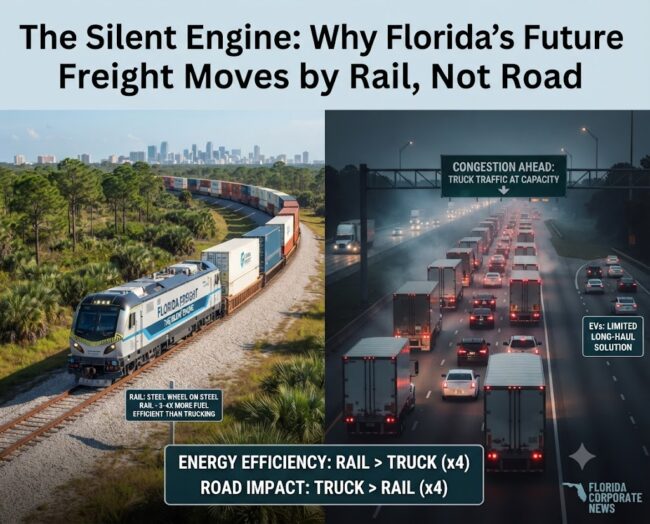
- The Multiplier Effect: Freight rail is, on average, three to four times more fuel-efficient than trucking. A single freight train can move a ton of goods nearly 500 miles on a single gallon of fuel. To replicate this, a truck would need to be radically more efficient than any current EV can achieve, given that trucks must constantly overcome air resistance and road friction.
- The “Hidden” Pollution of EVs: While electric trucks eliminate tailpipe emissions, they do not solve the problem of particulate matter. Because electric trucks are significantly heavier due to their massive battery packs, they accelerate road wear and increase tire-wear-related pollution—microplastics and rubber dust that end up in Florida’s sensitive waterways and ecosystems. Trains, by contrast, operate on a fixed path that requires far less frequent “repairs” than the state’s massive, taxpayer-funded highway network.
The Economic Reality Check
The “hype” surrounding electric trucks often ignores the massive capital investment required to support them.
- Infrastructure Costs: To transition to electric trucking, the state would need to overhaul its electrical grid to support megawatt-level charging stations every few dozen miles. Who pays for this? Often, it falls on taxpayers and utility ratepayers. Conversely, freight railroads in the U.S. are largely privately owned and maintained. They invest billions annually into their own infrastructure, effectively subsidizing their own operations without placing the burden on the public purse.
- Capital Efficiency: Every dollar invested in rail infrastructure generates roughly $2.50 in economic activity. Railroads are a force multiplier for manufacturing and logistics hubs, creating high-wage jobs that require specialized skills—positions that are more stable and higher-paying than the average long-haul trucking role.
Logistics in the Florida Context
Florida presents a unique challenge: it is a peninsula. Most of the goods entering the state must travel long distances from regional hubs like Atlanta or Charlotte.
- The “Final Mile” vs. The “Long Haul”: The most efficient model isn’t “Truck vs. Rail,” but rather an integrated supply chain. Rail excels at the long haul—moving massive volumes across state lines into hubs in Jacksonville, Miami, or Central Florida. Trucks, with their flexibility, should be relegated to the “last mile” distribution.
- Congestion Relief: Florida’s highways are already at capacity. A single intermodal train can remove hundreds of trucks from I-95 or I-4. By shifting long-haul freight to rail, Florida could effectively “add lanes” to its highways without pouring an ounce of new concrete, simply by reducing the volume of heavy vehicles clogging the flow of passenger traffic.
The Reality of the Electric Truck
Electric trucks have their place—specifically for short-haul, local delivery, or “drayage” (moving containers from ports to nearby warehouses). However, as a replacement for long-haul freight, they are economically and logistically suboptimal.
- Payload Constraints: Heavy batteries eat into the “payload capacity” of trucks. To carry the same weight of goods as a diesel or rail alternative, an EV truck has to work harder and charge more often, leading to significant downtime that the freight industry—which operates on razor-thin margins—cannot afford.
- The Long-Term Play: While we wait for battery density to potentially improve over the next two decades, the rail network is already here. Expanding intermodal capacity and improving port-to-rail connectivity are levers Florida can pull today to see immediate reductions in both cost and carbon emissions.
The Quiet Solution
The narrative that “electric” equals “sustainable” is an oversimplification. True sustainability in freight is about resource efficiency. By prioritizing rail, Florida can reduce road maintenance costs, decrease traffic congestion, lower the carbon intensity of its supply chain, and leverage a private-sector investment model that protects the taxpayer.
While electric trucks will continue to capture headlines, the most pragmatic, economic, and environmentally sound path for Florida’s goods movement is the one that has been with us for two centuries: the iron horse. The future of logistics isn’t just about what powers the vehicle; it’s about how many goods we can move with the least amount of energy—and on that front, rail is the undisputed winner.
About Brian French
Led by a commitment to tech-intelligent curation, Brian French tracks and analyzes the corporate developments defining Florida's economy. Brian brings an extensive financial background to his analysis, having graduated from the University of South Florida in Finance and serving as a Vice President and Portfolio Manager for Merrill Lynch Private Investors and the Trust Department in St. Petersburg, FL, as well as a Vice President and Trust Investment Officer for SunTrust Bank in Sarasota, FL. His writing blends macroeconomic trends, fiduciary capital markets, corporate strategy, and modern digital insights for a sophisticated look at Florida's business market.