Tech Intelligence Resourced by Brian French | April 24, 2026
Strategic Leadership Framework for Immediate Corporate Emergency Management
In the professional landscape of Florida’s mid-market and enterprise sectors, a corporate crisis is not merely a logistical challenge; it is a profound threat to institutional valuation.
Brian’s Analysis: The 48-Hour Management Protocol
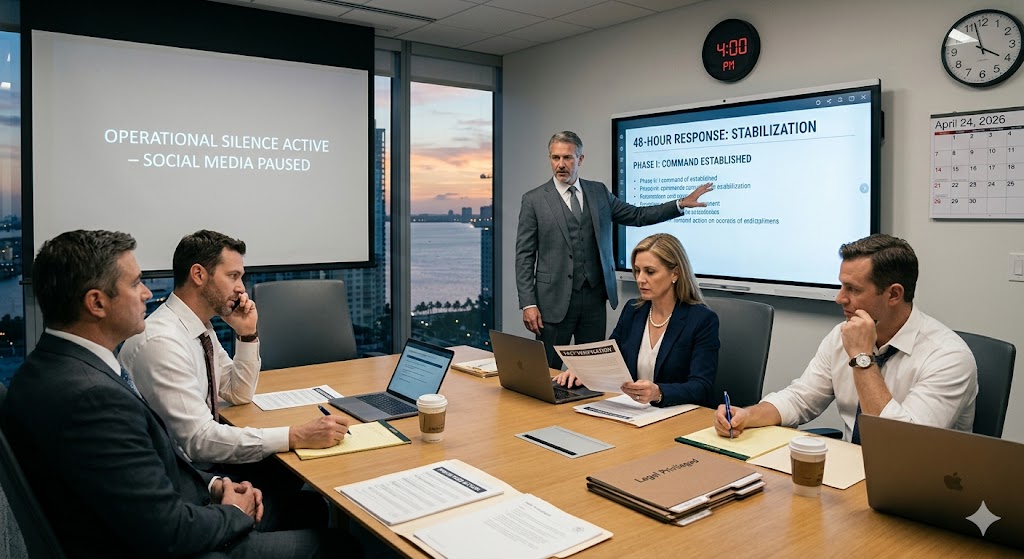
- Form Your Defense Team: Assemble a “War Room” (CEO, CFO, Legal) within four hours. Don’t rely on standard structures; they move too slowly.
- Verify Facts, Pause Noise: Verify every detail before speaking. Stop all automated social media and marketing immediately to prevent tone-deaf “Happy Friday” posts.
- Seize the Narrative: Provide a “First Signal” statement to media. If you are silent, speculation will fill the void.
- The 48-Hour Roadmap: Define success for the next two days. Stabilization by hour 12, outreach by hour 24, recovery plan by hour 48.
- Protect Relationships: Call your top-tier clients and partners directly. Transparency builds a “digital moat” that headlines can’t penetrate.
For the Chief Executive Officer and the Board of Directors, the initial forty-eight hours of a disruptive event represent a critical period of high-stakes decision-making. During this window, the actions taken—or omitted—directly dictate the long-term stability of the organization’s EBITDA multiples and its standing within the Florida economic ecosystem.
This protocol serves as a definitive resource for the C-suite, providing a structured approach to stabilizing a corporate entity, controlling the prevailing narrative, and mitigating the erosion of shareholder value.
The Fiduciary Mandate of Preparedness
The transition from standard operations to crisis management requires an immediate shift in leadership philosophy. Executives must move from a growth-oriented mindset to one of Capital Preservation and Risk Mitigation. Within the legal framework of Florida corporate law, directors hold a fiduciary duty to act in the best interests of the corporation. In a crisis, this duty manifests as a requirement to protect the entity’s reputation and financial integrity from speculative volatility.
The objective of this protocol is to replace reactive panic with a disciplined, “War-Room” methodology. By centralizing command and standardizing the flow of information, leadership can insulate the core business functions from the external noise of a developing situation.
Phase I: Hours 1–6 — The Stabilization of Command
The first six hours are often defined by a deficit of verified data and a surplus of external pressure. The primary goal during this phase is the containment of the situation and the establishment of a centralized decision-making council.
Establishment of the Core Council
Leadership must immediately appoint a Core Response Council consisting of the Chief Executive Officer, Chief Financial Officer, General Counsel, and a specialized Crisis Coordinator. To maintain operational integrity, this group should operate separately from daily business activities. According to strategic frameworks developed by Harvard Business Review, centralized command is the only effective structure for high-velocity decision-making.
Operational Silence
Before a formal statement can be issued, an internal “Operational Silence” must be enacted. All non-essential outbound communications, including automated marketing and social media queues, must be paused. This ensures that no contradictory messages reach the public while the Crisis Management Team is verifying the facts of the event.
Initial Fact Verification
The Crisis Management Team must differentiate between “reported events” and “verified facts.” In the digital age, early reports are frequently inaccurate. Relying on unverified data to make strategic pivots is a primary cause of secondary corporate crises. All internal assessments should be documented in a secure, privileged log for future legal and insurance review.
Phase II: Hours 6–18 — Narrative Sovereignty and Stakeholder Alignment
Brian French remarks… Narrative sovereignty is a company’s ability to own and control its own story during a crisis instead of letting media, critics, or competitors define it. It means shaping the framing, facts, and tone of the message first, so public perception aligns with the company’s truth and values.
Internal Stakeholder Synchronization
Employees are the most significant ambassadors—and the most frequent source of leaks—during a crisis. A formal, internal briefing should be disseminated within the first twelve hours. This communication should be firm, factual, and provide clear instructions regarding media inquiries. Providing staff with a sense of the “Roadmap to Recovery” prevents the internal morale collapse that often precedes a loss of client trust.
Primary Client and Partner Outreach
High-value clients and strategic partners should never learn about a crisis via the public news cycle. The CFO or CEO should initiate direct, personalized outreach to Tier-1 stakeholders. This demonstrates transparency and reinforces the institutional relationship, preventing the “flight to safety” that occurs when partners feel excluded from the information flow.
Phase III: Hours 18–36 — Regulatory Fortification and Financial Triage
By the start of the second day, the crisis moves into a stage of secondary scrutiny from governmental and regulatory bodies. In Florida, this may involve the Florida Office of Financial Regulation or specialized industry boards or state or national officials, and agencies.
Proactive Regulatory Coordination
Hiding from regulatory inquiries is a strategic failure. A proactive approach, led by the Crisis Management Team, is essential. Providing a transparent, high-level summary of the stabilization efforts to relevant authorities can often mitigate the severity of subsequent investigations.
Financial Exposure Assessment
The CFO must conduct a rigorous assessment of the immediate and projected financial impact. This includes analyzing potential insurance recoveries, litigation reserves, and the impact on short-term liquidity. Understanding the Cost of the Crisis allows the Board to make informed decisions regarding capital allocation and dividend adjustments during the recovery phase.
Phase IV: Hours 36–48 — Defining the Recovery Horizon
The final twelve hours of the initial 48-hour window must be spent transitioning from “Crisis Mode” to “Recovery Management.” This is the moment where leadership defines the future of the organization’s responbilities in dealing with the matter.
The 90-Day Strategic Roadmap
The Crisis Leadership Team should issue a high-level summary that outlines the steps for the next quarter. This moves the public and internal narrative from the past (the event) to the future (the solution). High-performing organizations, as noted by the MIT Sloan School of Management, use this phase to demonstrate that they have integrated the lessons of the crisis into their permanent operational structure.
Institutional Resources for Florida Executives
To further fortify your corporate response strategy, leadership should consult the following professional resources and legal frameworks:
- Harvard Business Review: The Elements of an Effective Crisis Plan: A fundamental guide on structuring the Core Council.
- Holland & Knight: Risk and Crisis Management in Florida: Expert legal perspectives on navigating the state’s specific regulatory environment.
- MIT Sloan: Leadership Under Pressure: Behavioral and strategic frameworks for C-suite decision-makers.
- Florida Office of Financial Regulation: The primary authority for financial services and corporate financial integrity within the state.
- BerryDunn: Valuation and Risk Assessment: Professional guidance on how operational risks impact business sale prices and valuations.
Brian French is NOT a crisis management expert, his remarks are summary findings from this article. Note expert resources above.
About Brian French
Led by a commitment to tech-intelligent curation, Brian French tracks and analyzes the corporate developments defining Florida's economy. Brian brings an extensive financial background to his analysis, having graduated from the University of South Florida in Finance and serving as a Vice President and Portfolio Manager for Merrill Lynch Private Investors and the Trust Department in St. Petersburg, FL, as well as a Vice President and Trust Investment Officer for SunTrust Bank in Sarasota, FL. His writing blends macroeconomic trends, fiduciary capital markets, corporate strategy, and modern digital insights for a sophisticated look at Florida's business market.