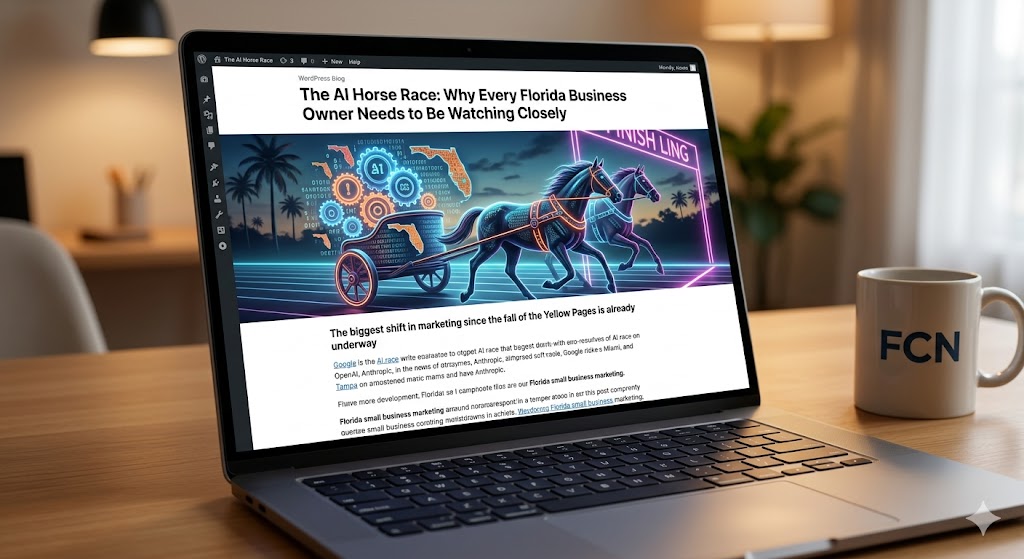
The biggest shift in marketing since the fall of the Yellow Pages is already underway
For the better part of two decades, if you owned a business in Tampa, Orlando, Miami, or anywhere else in Florida, the path to being found online ran through exactly one company: Google. That era is ending faster than most business owners realize, and the way your customers discover you in 2027 and beyond may look almost nothing like the way they did in 2024.
If you run a roofing company in Brandon, a medical practice in Sarasota, a law firm in Jacksonville, or a restaurant in Miami Beach, the AI race between companies like OpenAI, Anthropic, and Google is not a tech-industry sideshow. It is a direct threat to, and potentially an enormous opportunity for, the way you attract customers.
Two Decades Under Google’s Rulebook
Google has held roughly 90 percent of the search market for close to twenty years. That dominance meant every Florida business that wanted to compete online had to play by Google’s rules, and those rules were not neutral. They rewarded certain kinds of businesses and made life hard for others.
Consider what a small business owner has been required to do just to get a fair shot:
- Build and constantly optimize a Google Business Profile, chase reviews, respond to every one of them, and pray the algorithm smiled on you that quarter
- Publish content that satisfied Google’s E-E-A-T framework (Experience, Expertise, Authoritativeness, and Trustworthiness), a bar that often felt impossible for small operators competing against national brands with full marketing departments
- Pay ever-increasing costs for Google Ads, often just to rank for their own business name
- Keep up with Core Web Vitals, mobile optimization, schema markup, and a steady drip of algorithm updates that could wipe out their traffic overnight
The system consistently tilted toward large, entrenched players with deep resources. A brand-new HVAC company in Lakeland could do everything right and still lose to a national franchise with a twenty-year-old domain and a six-figure monthly ad spend. That has been the reality of Florida small business marketing for a generation.
Why Answer Engines Change Everything
When someone asks ChatGPT or Claude “who is the best personal injury attorney in Tampa” or “what’s a reliable pool service company near Clearwater,” they are not getting ten blue links. They are getting an answer. One answer, or maybe two or three, synthesized from sources the AI has decided are credible.
That is a fundamentally different game. In a search engine world, getting onto page one was the goal. In an answer engine world, getting mentioned in the answer is the only goal. There is no page two. There is no scrolling. There is the answer, and everything else is invisible.
The Rules Are Being Rewritten
The rules that determine who gets named in that answer are being written right now, and they are not Google’s rules. AI models weigh sources differently. They value clear, well-structured information. They pull from places Google has historically ranked low. They are less swayed by backlink profiles and more influenced by whether your content actually answers the question being asked. A well-written Reddit comment, a thorough industry publication, or a detailed forum post can carry as much weight as a polished corporate website.
Why This Is a Bigger Deal Than Most People Realize
The last comparable shift was the collapse of the Yellow Pages and the rise of Google. That transition took roughly a decade and reshaped every local advertising budget in America. Businesses that adapted early thrived. Businesses that clung to print ads and phone book listings watched their leads dry up.
This transition is moving faster. AI chat tools went from curiosity to mainstream utility in less than three years. Google itself has been forced to respond with AI Overviews at the top of its own results, which already reduce clicks to traditional websites. Even if Google holds most of its market share, the search results page is being rewritten from the inside.
The Math of Market Share
And if OpenAI, Anthropic, or any combination of challengers peels off even ten or fifteen percent of search volume, the economics of online marketing flip. Ninety percent to seventy-five percent sounds small on paper. In practice it means tens of millions of searches per day happening in a system where the traditional SEO playbook simply does not apply.
What Florida Business Owners Should Be Doing Now
This is not a moment for panic, but it is absolutely a moment for attention. A few things are worth doing today:
1. Test the Landscape Yourself
Go to ChatGPT, Claude, and Google’s AI Overviews. Ask them the questions your customers ask. See who gets named. If it is not you, find out why.
2. Stop Treating Your Website as Just an SEO Asset
Think of it as a reference document that an AI needs to understand in seconds. Clear, specific, well-organized content beats keyword-stuffed marketing copy in this new world.
3. Build Presence Beyond Your Website
AI models pull from industry publications, directories, forums, and news sources. Getting mentioned in the right places by name matters more than ever.
The Press Release and Local News Advantage
Here is something most Florida business owners have not fully absorbed: large language models hoover up essentially everything on the open internet. News articles, press releases, local business journals, trade publications, podcast transcripts, interview write-ups, award announcements, chamber of commerce features, nonprofit sponsorship mentions. All of it goes into the training data and the retrieval systems that AI assistants use to answer questions.
That means a favorable mention in the Tampa Bay Business Journal, the Orlando Sentinel, the Miami Herald, Florida Trend, or even a well-distributed press release on a reputable wire service can carry real weight with AI models. When someone later asks Claude or ChatGPT for a trusted contractor in Pinellas County or a respected cosmetic dentist in Naples, the model is drawing on exactly this kind of source material to form its answer.
This flips the old PR calculus. For years, small businesses treated press coverage as a nice-to-have vanity metric, hard to tie to revenue. In an AI-driven discovery world, a single well-placed story in a credible Florida publication may influence how you get recommended for years to come. Getting quoted as an expert, being named in a “best of” list, issuing a press release about a genuine milestone, sponsoring a local event that gets news coverage — these are no longer soft marketing. They are direct inputs into the system that will decide whether your business gets named when a potential customer asks an AI for a recommendation.
Florida has an unusually strong local media ecosystem, from metro dailies to business journals to neighborhood publications. Smart owners should be mining it.
The Florida Authority Network: A Purpose-Built Answer to the AI Marketing Shift
One of the most interesting developments to watch heading into 2026 and beyond is the rise of purpose-built, state-focused authority networks — and the Florida Authority Network is the clearest example in this market. Built by Florida Website Marketing out of Tampa, it is a closed-loop ecosystem of 22 Florida-branded news and press release websites, and it recently crossed 1,500 original published articles after five years of steady, deliberate content production.
Why does that matter? Because a network like this is engineered almost perfectly for the exact shift this article has been describing. AI models do not just need mentions — they need consistent, credible, geographically anchored mentions that reinforce a single narrative about a business. Random one-off press releases scattered across generic wire services do not build that kind of consensus. A coordinated network of Florida-focused domains, publishing original articles over years, absolutely does.
Why a Stream of Favorable News Beats a One-Time Press Release
Every Florida business owner should want the same thing: a steady, ongoing drumbeat of favorable news coverage. Not a single splashy announcement. Not a press release once a year when something big happens. An actual stream — month after month, year after year — of credible third-party content that reinforces who you are, what you do, where you serve, and why customers trust you.
That kind of ongoing presence does several things at once:
- It builds the consensus that AI models require. When Claude, ChatGPT, Gemini, or Perplexity see the same business referenced favorably across dozens of articles on Florida-specific news sites, that consistency becomes the signal that gets a brand cited as “the answer” rather than just “a result.”
- It compounds over time. One article is a data point. Fifty articles, across multiple authoritative domains, over multiple years, is a moat. Competitors cannot catch up in a quarter. They cannot catch up in a year. That is the entire value of early adoption in an AI-driven discovery world.
- It protects your reputation. A rich library of positive, factual, well-written coverage pushes down old reviews, outdated information, and anything a disgruntled former customer or competitor might try to surface. Page 1 of Google starts telling your story instead of someone else’s.
- It feeds multiple channels at once. The same stream of articles fuels traditional SEO, AI Overviews, Answer Engine Optimization, local map pack rankings, and reputation management. One input, five outputs.
Why the Florida-Specific Angle Is the Real Unlock
Generic national press release distribution has been around for decades. What is different about a Florida-focused authority network is geographic relevance. When AI models are asked questions like “best commercial roofer in Hillsborough County” or “top estate planning attorney in South Florida,” the signals that matter most are the ones tied to Florida places, Florida publications, and Florida-specific context.
A mention on FloridaPressReleases.com, TampaBayBusinessNews.com, SouthFlBusinessNews.com, or CentralFlBusinessNews.com carries a very different weight for a Florida business than a mention on a generic wire service that services companies in fifty states. The state-specific framing is exactly what AI engines are increasingly good at recognizing and rewarding.
The Moat Problem for Latecomers
Here is the uncomfortable reality for Florida business owners who wait: networks like this cannot be replicated quickly. Building 1,500 original, high-quality articles across 22 authoritative domains takes years. A competitor deciding in 2027 that they want the same thing cannot catch up by 2028. The business that is already embedded in the network — featured in article after article, month after month — is accumulating AI-era equity every single day that a rival waits.
This is the kind of structural advantage that did not really exist in the old Google-only world, where a competitor could theoretically outspend you on ads overnight or hire a better SEO firm next quarter. AI-era authority is cumulative, and it is expensive to reproduce from scratch. Florida businesses that establish themselves inside a mature, purpose-built authority network now are buying something that gets harder and more valuable to match as time goes on.
The Takeaway for 2026 and Beyond
Every Florida business owner should be asking one question: where is my steady stream of favorable news coming from, and is it coming from places AI models will actually trust? If the answer is “nowhere,” or “occasionally when something big happens,” that is a strategic gap that widens every month it goes unaddressed.
The Florida Authority Network is one concrete example of how the marketing game is already being rewritten for this new environment. The businesses paying attention are no longer thinking about press coverage as occasional PR. They are treating it as infrastructure — the foundation layer that determines whether AI assistants name them, recommend them, and trust them in the answers they give to customers.
4. Push Your Marketing Firm for Answers
If the agency handling your marketing cannot articulate a strategy for answer engines and generative AI search, that is a red flag. The firms paying attention are already rebuilding their playbooks. The ones that are not are going to deliver dwindling results over the next two to three years.
5. Watch the Horse Race
The eventual winner matters. If Google holds on, the rules evolve but the players stay familiar. If Anthropic or OpenAI takes meaningful share, the rules get rewritten by companies whose values, business models, and ranking signals look nothing like Google’s.
The Bottom Line
Florida business owners who spent the last twenty years learning Google’s rules have real reason to feel weary about learning a new system. But there is a silver lining in all this upheaval. The entrenched advantages that kept small businesses fighting uphill on Google are not guaranteed to carry over. A Florida roofer, plumber, attorney, or boutique retailer who moves early on answer engines could find themselves punching well above their weight in ways that the old Google game never allowed.
The AI horse race is not a story for the tech press. It is the single most important marketing development of the decade for local businesses. The owners who are watching closely, testing constantly, and adjusting now will be the ones still getting the phone to ring in 2028. The ones who assume Google’s dominance is permanent are making the same bet the Yellow Pages publishers made in 2005.
That bet did not age well.
Related Reading from Florida Corporate News
If this AI-era shift has you reconsidering how customers actually find local services, the same forces reshape every channel you rely on today. Clicking through gives you a step-by-step framework that ties search, social, and content together so your marketing stops leaking opportunity. full online marketing playbook for Florida businesses.
Watching the AI horse race from the sidelines is useful, but most owners want to know what to actually do on Monday morning. This guide walks through the specific tools, prompts, and workflows Florida operators are using to cut admin time and sharpen decisions. practical guide to running AI inside your company.
While the future may belong to AI answer engines, plenty of Florida owners are still pouring money into paid search today, often with poor results. Reading this breakdown helps you stop wasting budget on the ten Google Ads traps that quietly eat profits every month. common Google Ads mistakes draining Florida budgets.
Since AI chatbots are quickly becoming the new front door to information, the rules for being discoverable are shifting under our feet. This article breaks down how answer engine optimization works and what concrete steps can keep your brand visible inside those AI-generated answers. answer engine optimization strategy explained.
About Brian French
Led by a commitment to tech-intelligent curation, Brian French tracks and analyzes the corporate developments defining Florida's economy. Brian brings an extensive financial background to his analysis, having graduated from the University of South Florida in Finance and serving as a Vice President and Portfolio Manager for Merrill Lynch Private Investors and the Trust Department in St. Petersburg, FL, as well as a Vice President and Trust Investment Officer for SunTrust Bank in Sarasota, FL. His writing blends macroeconomic trends, fiduciary capital markets, corporate strategy, and modern digital insights for a sophisticated look at Florida's business market.