June 13, 2026
Florida has become one of the most fertile grounds for entrepreneurship in the country. No state income tax, a steady flow of new residents, and a business climate that rewards the bold have turned the Gulf and Atlantic coasts into a launchpad for everyone from solo operators to franchise empires. But ask most owners what their business costs them, and they’ll reach for a calculator. Rent. Payroll. Insurance premiums that climb a little higher every hurricane season. Dollars and cents.
That’s the easy math. It’s also the wrong math.
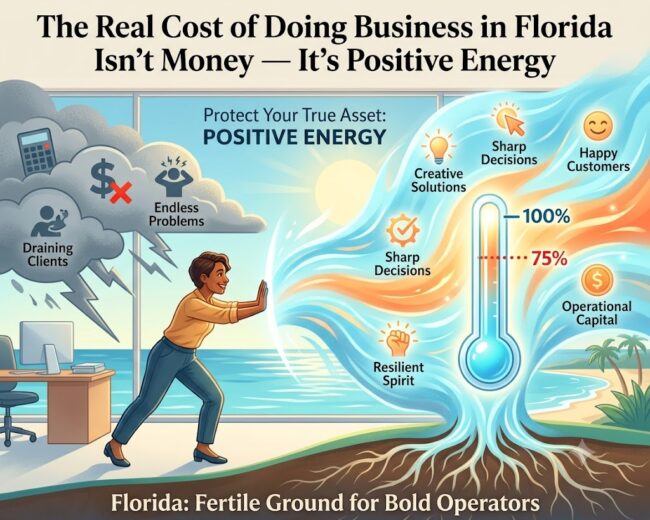
The most valuable resource in any business is not money. Money is replaceable — you can borrow it, raise it, earn it back next quarter. The truly scarce assets are time and, above all, positive energy. And while you can run a rough back-of-the-napkin calculation on time versus earnings, the invisible cost of the clients and circumstances that quietly drain your positive energy is the biggest thief in business. It never shows up on the balance sheet, but it’s stealing from you all the same.
The Two Currencies Nobody Tracks
Time, at least, can be estimated. You know roughly what an hour of your attention is worth, and you can decide whether a project, a meeting, or a difficult account is worth the clock.
Positive energy is harder to pin down, which is exactly why it gets robbed so easily. It’s the resource that fuels good decisions, sharp service, creative problem-solving, and the kind of presence that makes customers want to come back. When it’s high, the whole operation hums. When it’s depleted, even simple tasks feel like wading through wet sand — and the people around you feel it too.
A well-managed business has very few leaks. The owner has anticipated the predictable problems and pre-mitigated them before they ever reach the floor. In practice, that means building processes you can run reliably — call it a 90% efficiency rate or better, where the routine simply works and rarely demands your emotional reserves. Systems exist precisely so you don’t have to spend energy reinventing the same wheel every morning.
The 75% Threshold
Here’s where it gets dangerous. You can build the tightest systems in Tampa Bay, and a single troubling client, a difficult employee, or an unforeseen flaw in the plan can still puncture your reserves. If that drain pulls your positive energy below a certain threshold — say, 75% — the whole operation is suddenly at risk. Not because the numbers changed, but because the person steering the ship is running on fumes.
This is the part owners underestimate. We tend to treat morale and mindset as luxuries — nice to have when business is good. They’re not luxuries. They’re operating capital. Drop below the line and your judgment dulls, your patience thins, and the next decision is worse than the last. Energy debt compounds faster than any loan.
Take Inventory. Then Protect It.
Owners and managers need to take inventory of their positive energy the same way they count cash in the register. Where is it going? Who is drawing it down? Which accounts give back more than they take, and which ones quietly bleed you dry?
Once you know, the job is to groom that energy, cherish it, and — more important than anything else — protect it. Guarding your reserves is not soft; it’s operational discipline. The most successful Florida operators I’ve watched aren’t the ones who grind themselves to nothing chasing every dollar. They’re the ones who recognize that the dollar isn’t always worth what it costs to earn.
Which leads to an uncomfortable truth: sometimes you have to accept a minor drop in income when a client is stealing your energy. The account that pays on time but leaves you rattled for a week is not a good account. The math that ignores your depleted state isn’t honest math. Letting go of a poisonous client is not a loss — it’s a recovery.
Thick Skin Has a Limit
None of this is an argument for fragility. We’re all human, and a thick skin is a requirement for anyone running a business — you will take hits, hear “no,” eat the occasional bad review, and weather the storm season after season. That comes with the territory.
But there’s a difference between a hit you can absorb and a circumstance that pushes deeper, past the surface, into the reserves that keep you functioning. When something or someone crosses that line, it is time to respond in self-defense. Set the boundary. End the relationship. Restructure the role. Protect the asset.
Because in the end, money comes and goes, seasons turn, and the market does what it does. But nothing stops the train of positive energy. Guard it, and the business runs. Lose it, and no amount of revenue will get the engine moving again.
About Brian French
Led by a commitment to tech-intelligent curation, Brian French tracks and analyzes the corporate developments defining Florida's economy. Brian brings an extensive financial background to his analysis, having graduated from the University of South Florida in Finance and serving as a Vice President and Portfolio Manager for Merrill Lynch Private Investors and the Trust Department in St. Petersburg, FL, as well as a Vice President and Trust Investment Officer for SunTrust Bank in Sarasota, FL. His writing blends macroeconomic trends, fiduciary capital markets, corporate strategy, and modern digital insights for a sophisticated look at Florida's business market.